
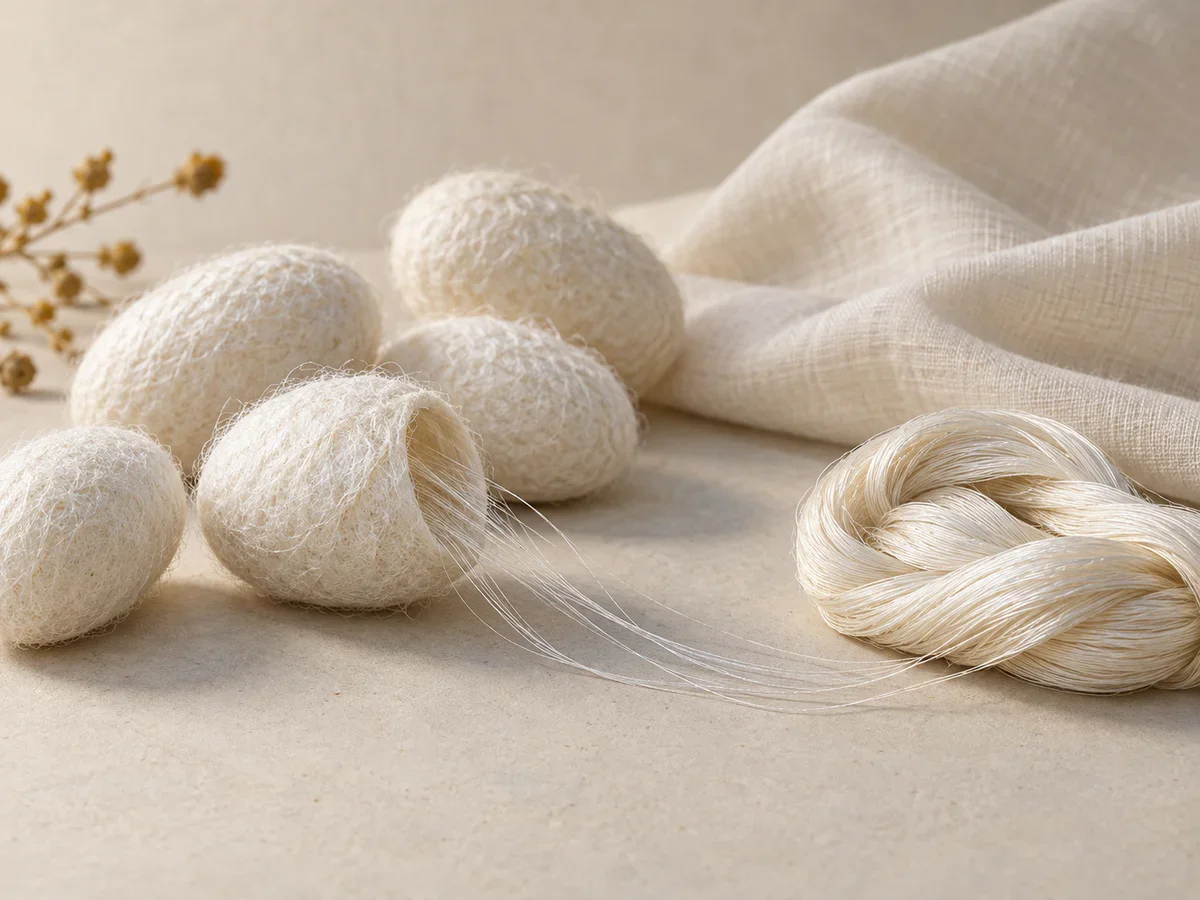
Silk is a natural, animal-origin protein fiber produced by silkworm larvae as they form cocoons. In conventional cultivated silk production, the principal source is the silkworm Bombyx mori. Its long cocoon filament can be reeled, combined with other filaments, and later processed into yarn and fabric. Short or broken silk fibers can instead be prepared as staple and spun.
The word “silk” is often applied to several different material states. Understanding the difference between fiber, filament, yarn, and fabric is the best starting point for evaluating silk products and technical descriptions.
Silk fiber, filament, yarn, and fabric
A silk filament is the continuous strand secreted by a silkworm as it forms a cocoon. The term silk fiber may refer broadly to this textile material in either continuous-filament or discontinuous-staple form.
During reeling, filaments from several cocoons are unwound together to form an untwisted raw-silk thread. Further cleaning, twisting, and doubling—operations collectively associated with silk throwing—prepare reeled silk for use as yarn. Weaving then interlaces yarns to make fabric.
When silk exists as short or broken lengths, the fibers can be opened, aligned, and spun into yarn. Staple silk describes the discontinuous fiber form; spun silk describes yarn made from those short fibers. Neither term describes a fabric construction.1
Biological origin and composition
The Bombyx mori larva secretes protein material and draws it into a cocoon filament. That filament contains two fibroin components joined and coated by sericin.
- Fibroin forms the structural core of the filament.
- Sericin is the gum-like protein that binds and protects the fibroin components.
Silk is therefore a protein fiber, unlike plant fibers based principally on cellulose. Raw, still-gummed silk retains sericin. Degumming removes some or all of that coating, exposing the fibroin filaments and changing the silk’s handle, appearance, and processing behavior.2
Principal types of textile silk
For a general introduction, silk can be organized into a small number of commercially important groups:
- Mulberry silk is cultivated silk associated with Bombyx mori and mulberry food plants.
- Tasar or tussah silk is a non-mulberry group that includes tropical and oak-associated types.
- Muga silk is a separate non-mulberry commercial group.
- Eri silk is a non-mulberry group whose open-ended cocoons are associated with spinning rather than ordinary continuous reeling.
These categories come from different silkworm species and food plants, and they do not necessarily yield fibers with the same color, continuity, surface, or processing route.
Terms such as wild silk, non-mulberry silk, and vanya silk overlap in industry usage, but they are not universally interchangeable scientific categories. “Wild silk” is commonly associated with silk outside conventional cultivated mulberry production, while “vanya silk” is an Indian industry umbrella term for non-mulberry groups. A general page should preserve these distinctions without turning them into an exhaustive species catalogue.3
How continuous filament silk is obtained
The initial production sequence is short in principle, although each step requires control in practice:
- Silkworm larvae form cocoons from continuous filament.
- Intact cocoons are collected for sericulture processing.
- Drying or another heat treatment prevents an emerging moth from breaking the continuous filament.
- Water and heat soften the hardened sericin around the cocoon filament.
- Filament ends are found, and filaments from several cooked cocoons are unwound together.
- The combined raw-silk thread is wound onto a reel.
This is reeling. It is distinct from later re-reeling, throwing, degumming, dyeing, finishing, and weaving. Those later operations convert the reeled material into forms suitable for particular yarns and fabrics.4
Reeled silk, silk waste, and spun silk
Not every cocoon or filament can be continuously reeled. Pierced or otherwise unreelable cocoons, material brushed from cocoons, irregular filament sections, and waste created during reeling can still be useful silk feedstock. Collectively, such material may be described as silk waste. The term identifies its position in the production process; it does not mean that the material is not silk.
After suitable degumming and cleaning, discontinuous silk material can be opened, carded, and combed so the fibers are more nearly parallel. It can then be spun into yarn.
| Material term | Meaning at this page’s level |
|---|---|
| Reeled silk | Continuous cocoon filaments unwound and combined into raw-silk thread |
| Silk waste | Silk material unsuitable for normal continuous reeling or throwing |
| Staple silk | Discontinuous silk fibers prepared in short lengths for spinning |
| Spun silk | Yarn made by spinning prepared silk staple |
| Silk noil | The shorter prepared fraction associated with silk-waste processing |
Spun silk is generally softer, less lustrous, and more textured than reeled filament silk. Because its yarn is assembled from short fibers, its surface may also become fuzzier with wear. These are differences in material form and construction, not evidence that spun silk is an imitation fiber.4
Core properties and practical behavior
Silk’s useful textile behavior comes from a combination of properties rather than one universal measure.
- Luster and color response: Silk can show a distinctive sheen and has a useful affinity for dyes, supporting clear and rich color effects.
- Strength and elasticity: Silk combines useful strength with the ability to extend. Its behavior changes with moisture, and wet silk can lose some strength until it dries.
- Moisture interaction: Silk is absorbent. This affects comfort, dyeing, finishing, dimensional behavior, and handling during wet processing.
- Thermal handle: Silk conducts heat poorly, contributing to a characteristically warm handle.
- Drape and resilience: Its light weight, flexibility, and resilience help silk yarns and fabrics form fluid or structured surfaces depending on construction and finishing.
These statements are qualitative. Silk properties vary with fiber type, filament or staple form, retained sericin, yarn and fabric construction, finishing, condition, and test method. A single performance ranking should not be generalized to every silk product.5
Why silk varies
Silk is not one completely uniform material. Variation begins before the fiber is processed and continues through use and ageing.
Important influences include:
- silkworm species or breed and its food plant;
- cocoon layer, natural pigment, and filament continuity;
- rearing and cocoon-forming conditions;
- cocoon integrity, drying, and storage;
- cooking and reeling control;
- the amount of sericin retained or removed;
- reeled-filament versus spun-staple construction;
- dyeing, weighting, and other finishes;
- exposure to light, heat, moisture, chemicals, and wear.
This variation explains why two materials described simply as “silk” may differ visibly in luster, color, smoothness, texture, strength, or drape. Product-specific claims should identify the silk form and relevant processing context whenever those details affect the conclusion.3
Common applications
Silk is used across several textile application groups:
- apparel and linings;
- furnishings and upholstery;
- carpets and rugs;
- sewing, knitting, and embroidery threads;
- decorative and pile fabrics;
- blends with other fibers.
Reeled filament is suited to smooth, lustrous yarns and fabrics, while spun silk and noil support softer, more textured effects. The final behavior depends as much on yarn, construction, and finishing as on the fiber name alone.
Technical references also record silk in insulation and as a covering for wire in electrical equipment. These examples establish a technical-use group beyond apparel and interiors; they do not imply that every historical use remains widespread today.6
Processing, use, and care sensitivities
Silk’s protein structure requires controlled handling. Prolonged light exposure, especially ultraviolet radiation, can weaken and discolor it. Heat and moisture can accelerate deterioration, while strong mineral acids, strong alkalis, chlorine, and other oxidizing agents can damage the fiber. Overly severe degumming or other wet processing can also reduce strength.
Because wet silk can be temporarily weaker, it should be handled more gently while wet. Silk that has been weighted with metallic salts may be especially vulnerable to deterioration.
These are fiber-level cautions, not a universal cleaning prescription. Appropriate care for a particular textile also depends on its dyes, finishes, yarn and fabric construction, trims, prior damage, and current condition.2
Terminology cautions
- Raw silk means reeled silk that still retains its gum in the production sequence. It should not be used as a casual synonym for spun silk or silk noil.
- Silk waste is genuine silk feedstock that cannot follow the normal continuous-reeling route.
- Spun silk, silk noil, and reeled silk identify different material forms and should not be interchanged.
- Tasar and tussah are name variants used for a non-mulberry silk group.
- Artificial silk was a historical name applied to viscose, later called rayon. The reviewed evidence does not establish art silk as a controlled equivalent, so that wording should be treated as ambiguous rather than as evidence of silk-fiber content.
Ethical modifiers such as “peace silk” and “Ahimsa silk” are not defined here. Their meaning and the production claims attached to them require separate, carefully scoped evidence.7
Scope note
This introduction does not make numerical performance comparisons, sustainability or animal-welfare conclusions, certification claims, legal-labeling interpretations, or current market statements. Those subjects require separate evidence matched to a defined method, geography, date, standard, or rule.
Citations
-
- Silk Reeling and Testing Manual — Food and Agriculture Organization of the United Nations · FAO Agricultural Services Bulletin No. 136; ISBN 92-5-104293-4 · 1999.
- Key Components — International Sericultural Commission.
- Natural Fibres — Canadian Conservation Institute Notes 13/11 — Canadian Conservation Institute, Government of Canada · CCI Notes 13/11; originally published 1986; revised 1996 and 2008; web page dated 2019-02-22 · 2008.
-
- Silk Reeling and Testing Manual — Food and Agriculture Organization of the United Nations · FAO Agricultural Services Bulletin No. 136; ISBN 92-5-104293-4 · 1999.
- Natural Fibres — Canadian Conservation Institute Notes 13/11 — Canadian Conservation Institute, Government of Canada · CCI Notes 13/11; originally published 1986; revised 1996 and 2008; web page dated 2019-02-22 · 2008.
-
- Silk Reeling and Testing Manual — Food and Agriculture Organization of the United Nations · FAO Agricultural Services Bulletin No. 136; ISBN 92-5-104293-4 · 1999.
- Silk — Central Silk Board, Ministry of Textiles, Government of India.
- Natural Fibres — Canadian Conservation Institute Notes 13/11 — Canadian Conservation Institute, Government of Canada · CCI Notes 13/11; originally published 1986; revised 1996 and 2008; web page dated 2019-02-22 · 2008.
-
- Silk Reeling and Testing Manual — Food and Agriculture Organization of the United Nations · FAO Agricultural Services Bulletin No. 136; ISBN 92-5-104293-4 · 1999.
- Key Components — International Sericultural Commission.
-
- Silk Reeling and Testing Manual — Food and Agriculture Organization of the United Nations · FAO Agricultural Services Bulletin No. 136; ISBN 92-5-104293-4 · 1999.
- Silk — An Introduction — International Sericultural Commission.
- Natural Fibres — Canadian Conservation Institute Notes 13/11 — Canadian Conservation Institute, Government of Canada · CCI Notes 13/11; originally published 1986; revised 1996 and 2008; web page dated 2019-02-22 · 2008.
-
- Silk Reeling and Testing Manual — Food and Agriculture Organization of the United Nations · FAO Agricultural Services Bulletin No. 136; ISBN 92-5-104293-4 · 1999.
- Silk — An Introduction — International Sericultural Commission.
- Key Components — International Sericultural Commission.
-
- Silk Reeling and Testing Manual — Food and Agriculture Organization of the United Nations · FAO Agricultural Services Bulletin No. 136; ISBN 92-5-104293-4 · 1999.
- Key Components — International Sericultural Commission.
- Silk — Central Silk Board, Ministry of Textiles, Government of India.
- Charles Frederick Cross — Science Museum Group Collection.