
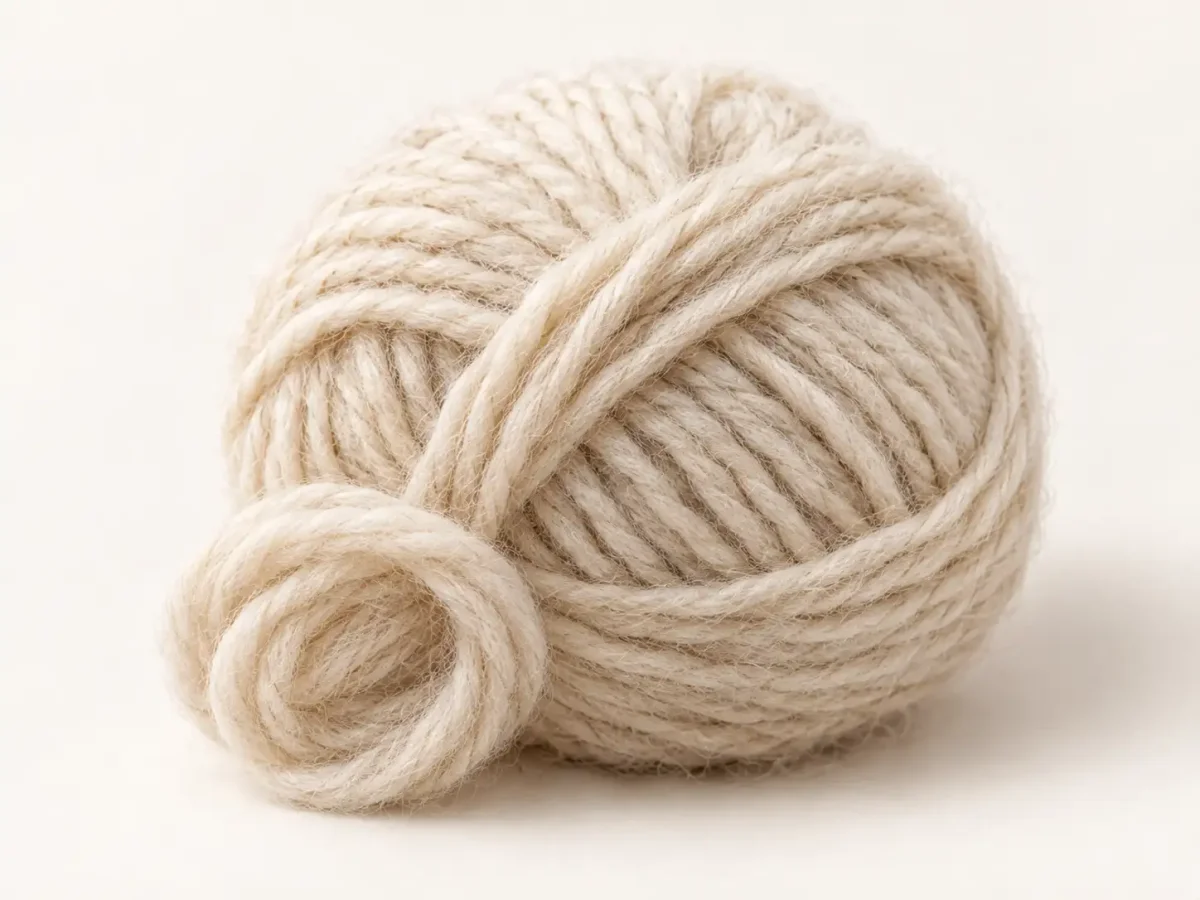



Wool is a natural protein fiber grown by sheep. Wool fibers can combine crimp, bulk, moisture interaction, flexibility, and resilience in forms suited to products ranging from clothing to carpets and felt, but not every wool behaves the same way.
This page uses wool specifically for sheep fiber. Cashmere, mohair, alpaca, angora, camel, and yak fibers belong to the wider animal-fiber family, but they come from different animals and should be identified by their own names. This is an editorial scope distinction, not a legal labeling definition.1
What wool is made of
Wool is composed chiefly of keratin, a protein also found in other animal fibers. Its structure is hierarchical: small protein components are organized into larger structures, cells, and finally the complete fiber.
At an introductory level, two regions explain much of wool’s textile behavior:
- The cuticle is the outer layer. It consists of overlapping, scale-like cells that protect the fiber and create different friction depending on the direction of movement.
- The cortex forms most of the fiber body. Its elongated cells contain keratin filaments held within a protein matrix. Sulfur-containing cross-links help give the structure cohesion while allowing extension and recovery.
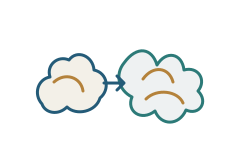
Differences that develop across the fiber contribute to wool’s natural waviness, called crimp. Crimp formation is complex, so it should not be attributed to one structural feature alone. Some coarser fibers may also contain a central medulla, but a medulla is not present in every wool fiber.2
From fleece to prepared fiber
Wool processing begins when the fleece is removed from the sheep by shearing. The shorn fleece is prepared by separating lower-value or unsuitable portions and removing obvious contamination. Lots may then be opened or blended before cleaning.
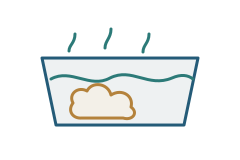
As-shorn greasy wool contains wool grease or wax, suint, dirt, and often vegetable matter. Scouring washes out the principal natural and acquired impurities. The wool is then rinsed and dried. If troublesome vegetable matter remains, an additional removal process may be needed, but this is not a universal step.
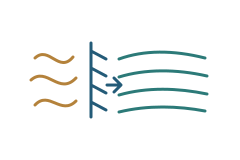
Carding is the next important transition toward yarn manufacture. It separates entangled tufts into a more even web or sliver. Later operations can include gilling, combing, drafting, and spinning, depending on the chosen system, but those processes are beyond this introductory fiber page.3
In short:
Shearing → fleece preparation → opening or blending as required → scouring → rinsing and drying → carding for further manufacture
How wool varies
Wool varies between breeds, animals, fleeces, and even different parts of one fleece. Its name alone does not predict how a finished textile will feel or perform.
Fiber diameter and fineness
Fiber diameter is a central description of wool. Mean fiber diameter is the average diameter of the fibers in a tested sample and is normally reported in micrometers (µm). A micrometer—often informally called a micron—is a unit of measurement, not a fiber grade.
Diameter and the distribution of diameters influence softness, bending behavior, processing, yarn possibilities, and next-to-skin comfort. Fineness should therefore be discussed as a measured fiber characteristic rather than as a vague synonym for overall quality.4
Staple length and strength
A staple is a naturally associated lock or cluster of fibers in the fleece. Staple length describes that structure in greasy wool. It is not the same as the length distribution measured after processing, because fibers can break or be removed during preparation.
Staple strength also matters: weak or tender portions can break more readily during processing. Length and strength help determine how efficiently a wool can be prepared for a particular yarn route.1
Crimp
Crimp is the natural waviness or curvature along a wool fiber. Its frequency and regularity vary. Crimp often relates to fiber diameter, but the relationship is not exact enough to use crimp as a substitute for measurement.
Within a textile assembly, crimp contributes bulk, spaces between fibers, elasticity, and recovery after compression. These effects help explain why different wools suit different product structures.5
Color and contamination
Wool may differ in natural color or show discoloration. Color affects the appearance that can be achieved and the shades for which the material is suitable.
Greasy-wool condition and fleece faults can include wool grease, suint, soil or dust, vegetable matter, stains, second cuts, and foreign or off-type fibers. Some are removable impurities; others require separate handling or may remain a quality limitation. “Clean” wool should therefore not be understood as a promise that absolutely no residual matter is present.6
Why wool behaves the way it does
Wool’s performance depends on both the fiber and the way fibers are assembled into yarn, fabric, felt, filling, or another product.
Insulation and bulk
Crimp helps create a bulky fiber assembly with spaces that can retain still air. It is this combination of fiber and structure—not the fiber name alone—that supports thermal insulation. Fabric thickness, density, construction, moisture, and use conditions still affect the result.7
Moisture interaction
Parts of the keratin structure can take up and release water vapor. At the same time, the outer surface can delay wetting by liquid water. Together, these features allow wool textiles to buffer moisture around the body or within a product. They do not make every wool textile waterproof, and performance varies with construction and finishing.5
Elasticity and resilience
Keratin filaments, their cross-linked matrix, and the fiber’s crimp contribute to extension, recovery, and resistance to compression. These tendencies can help yarns and fabrics retain bulk or recover shape, but the finished product determines how much of that behavior is expressed.7
Felting
The cuticle’s overlapping scales produce directional friction. With fiber movement—especially when moisture, heat, and mechanical action are involved—fibers can migrate and interlock. This behavior is useful when making felt, but it can also cause irreversible felting and dimensional shrinkage in susceptible textiles.7
Practical limitations
Wool needs to be matched to its end use and cared for as a finished product.
- Felting and shrinkage: Untreated or susceptible wool textiles may compact when wet and mechanically agitated. A single universal washing instruction is therefore inappropriate; follow the product’s care label and account for any finish or shrink-resist treatment.8
- Skin comfort: Some fabrics can feel prickly when sufficiently stiff, coarser fiber ends protrude from the surface and press against the skin. Fiber diameter and its distribution matter, but yarn structure, fabric construction, and finishing also influence the sensation. This mechanical-prickle explanation should not be turned into an allergy or medical claim.9
- Wear and durability: Wool’s structure provides flexibility, resilience, and surface protection, but abrasion resistance and service life belong to the whole product. Fiber condition and strength, yarn and fabric construction, finishing, care, and use all contribute. Wool should not be assigned a universal durability ranking without product-specific test evidence.8
Common uses
Wool’s two broad traditional end-use groups are apparel and carpets. It is also used in interior textiles, felted products, fillings, insulation, and specialized components.10
Different uses favor different combinations of characteristics:
- Finer, more uniform fibers can support softer apparel and next-to-skin products.
- Longer, stronger fibers can support alignment and preparation for smoother yarns.
- Coarser, bulkier, or more resilient wools can suit carpets and interior products.
- Scale-assisted interlocking makes wool suitable for felt.
- Crimp and the bulk it creates support fillings and insulation structures.
These are general relationships, not fixed grades or universal thresholds. Product design and processing remain decisive.11
Terms that are easy to confuse
| Term | Meaning on this page |
|---|---|
| Animal fiber | The wider group that includes sheep wool and named fibers such as cashmere, mohair, and alpaca. |
| Wool | Sheep fiber within the scope of this module. |
| Fleece | The coat or shorn mass from an individual animal; use shorn fleece when the process stage matters. |
| Greasy wool | Wool in the as-shorn, unscoured state, carrying grease or wax, suint, dirt, and possible vegetable matter. |
| Raw wool | A term used with varying breadth. Define the intended state instead of assuming it always means exactly the same as greasy wool. |
| Scoured wool | Wool that has undergone commercial cleaning to remove grease and other impurities. |
| Woollen, semiworsted, and worsted | Processing and yarn-making routes—not sheep species or intrinsic fiber types. |
Scope note
This introduction does not make numerical performance comparisons, sustainability or animal-welfare conclusions, certification claims, legal-labeling interpretations, or current market statements. Those subjects require separate evidence matched to a defined method, geography, date, standard, or rule.
Citations
-
- Harvesting of Textile Animal Fibres — Food and Agriculture Organization of the United Nations · FAO Agricultural Services Bulletin No. 122; ISBN 92-5-103759-0 · 1995.
- The science behind the wool industry: The importance and value of wool production from sheep — Animal Frontiers / Oxford University Press · doi:10.1093/af/vfab005 · 2021-05-17.
-
- Wool: From Properties and Structure to Genetic Insights and Sheep Improvement Strategies — Animals / MDPI · doi:10.3390/ani15192790; PMID:41096386 · 2025-09-25.
- Harvesting of Textile Animal Fibres — Food and Agriculture Organization of the United Nations · FAO Agricultural Services Bulletin No. 122; ISBN 92-5-103759-0 · 1995.
- The science behind the wool industry: The importance and value of wool production from sheep — Animal Frontiers / Oxford University Press · doi:10.1093/af/vfab005 · 2021-05-17.
-
- Harvesting of Textile Animal Fibres — Food and Agriculture Organization of the United Nations · FAO Agricultural Services Bulletin No. 122; ISBN 92-5-103759-0 · 1995.
- Wool Processing — Australian Wool Education Trust / Woolwise · WOOL 382-482; revised 2012 · 2012.
-
- The science behind the wool industry: The importance and value of wool production from sheep — Animal Frontiers / Oxford University Press · doi:10.1093/af/vfab005 · 2021-05-17.
-
- Wool: From Properties and Structure to Genetic Insights and Sheep Improvement Strategies — Animals / MDPI · doi:10.3390/ani15192790; PMID:41096386 · 2025-09-25.
- The science behind the wool industry: The importance and value of wool production from sheep — Animal Frontiers / Oxford University Press · doi:10.1093/af/vfab005 · 2021-05-17.
-
- Harvesting of Textile Animal Fibres — Food and Agriculture Organization of the United Nations · FAO Agricultural Services Bulletin No. 122; ISBN 92-5-103759-0 · 1995.
- The science behind the wool industry: The importance and value of wool production from sheep — Animal Frontiers / Oxford University Press · doi:10.1093/af/vfab005 · 2021-05-17.
- Wool Processing — Australian Wool Education Trust / Woolwise · WOOL 382-482; revised 2012 · 2012.
-
- Wool: From Properties and Structure to Genetic Insights and Sheep Improvement Strategies — Animals / MDPI · doi:10.3390/ani15192790; PMID:41096386 · 2025-09-25.
-
- Wool: From Properties and Structure to Genetic Insights and Sheep Improvement Strategies — Animals / MDPI · doi:10.3390/ani15192790; PMID:41096386 · 2025-09-25.
- Wool Processing — Australian Wool Education Trust / Woolwise · WOOL 382-482; revised 2012 · 2012.
-
- Debunking the Myth of Wool Allergy: Reviewing the Evidence for Immune and Non-immune Cutaneous Reactions — Acta Dermato-Venereologica · doi:10.2340/00015555-2655; PMID:28350041 · 2017-08-31.
- The science behind the wool industry: The importance and value of wool production from sheep — Animal Frontiers / Oxford University Press · doi:10.1093/af/vfab005 · 2021-05-17.
-
- Harvesting of Textile Animal Fibres — Food and Agriculture Organization of the United Nations · FAO Agricultural Services Bulletin No. 122; ISBN 92-5-103759-0 · 1995.
-
- Wool: From Properties and Structure to Genetic Insights and Sheep Improvement Strategies — Animals / MDPI · doi:10.3390/ani15192790; PMID:41096386 · 2025-09-25.
- Harvesting of Textile Animal Fibres — Food and Agriculture Organization of the United Nations · FAO Agricultural Services Bulletin No. 122; ISBN 92-5-103759-0 · 1995.
- Wool Processing — Australian Wool Education Trust / Woolwise · WOOL 382-482; revised 2012 · 2012.