
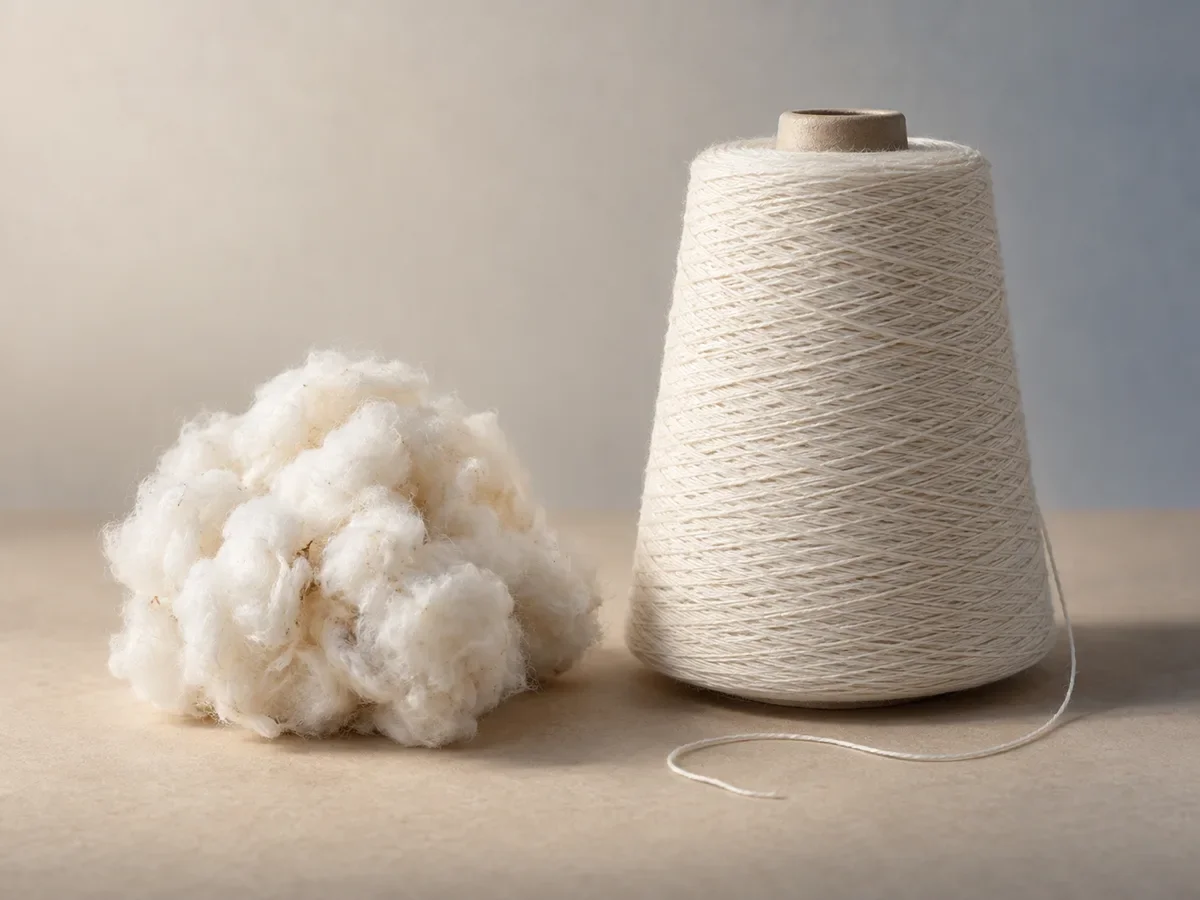
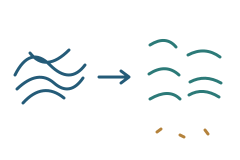
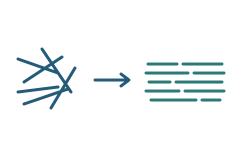
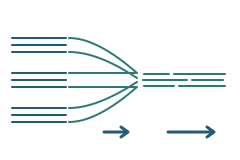
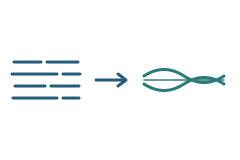
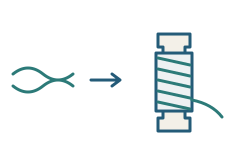
Spinning turns prepared staple fibers into yarn. Staple fibers have finite lengths; a continuous filament is a fiber treated as continuous along its length.1 This introduction follows a short-staple cotton example and explains the terms needed to read a process description.
What spinning means here
The word has two related uses. Manufactured-fiber spinning forms filaments, which can remain continuous or be converted into staple. Staple-yarn spinning starts with existing fibers and assembles them into yarn. A spun yarn is therefore different from a filament yarn.1
Recognizing the material between machines
- Sliver: a long, untwisted strand of largely parallel staple fibers, prepared for further drafting.
- Roving: a draftable strand with a small amount of twist, used during preparation for spinning.
- Twist: the spiral arrangement of the strand’s components. It usually helps bind staple fibers into spun yarn.2
Sliver and roving name intermediate forms. They should not be read as interchangeable names for finished yarn.2
Preparing cotton for spinning
A simplified carded-cotton ring route is opening and cleaning → carding → drawing → roving → ring spinning. It is an example, not a sequence required for every spinning system.34
| Preparation | Purpose in this example |
|---|---|
| Opening and cleaning | Open and mix fiber tufts; remove unwanted material. |
| Carding | Further clean and align fibers, delivering sliver. |
| Drawing | Combine slivers and draw them down through rollers, improving alignment and blending. |
| Roving | Reduce the strand further and add light twist for handling before ring spinning. |
Drafting reduces the fiber strand’s mass per unit length. In roller drafting, successive roller pairs run faster toward the delivery end, pulling fibers through the strand.3
Combing is an additional preparation step used in some routes to remove shorter fibers. It is not required for every cotton yarn. Roving is also route-dependent: the rotor and air-jet systems described below take sliver directly.34
Three yarn-formation methods
Ring spinning takes roving through drafting rollers. The rotating spindle and ring-and-traveler arrangement provide twisting and winding onto a bobbin. Ring-spun identifies this formation method.4
Rotor spinning, commonly called open-end spinning in this context, feeds sliver to an opening roller. Separated fibers enter a rotating cup and join the open yarn end; the formed yarn is withdrawn continuously.4
Air-jet spinning roller-drafts sliver and uses swirling air to form yarn. The fiber arrangement needs a qualification: in the Rieter air-jet structure documented in its technical study, wrapping fibers surround a core, and twist belongs to those wrappers. This should not be pictured as uniform twisting of every fiber through the whole strand.45
When reading a yarn description, separate preparation from formation: combed refers to preparation, while ring-spun, rotor-spun and air-jet-spun identify the spinning method.34 For yarn forms, construction, twist direction and count, continue to Yarn Fundamentals.
Citations
-
- Terminology of Man-Made Fibres — International Bureau for the Standardization of Man-Made Fibres (BISFA) · 2017 Edition · 2017. Evidence locator: Chapter 2 morphological scheme, printed p. 21; Chapter 3, Spun yarn, printed p. 46.
-
- Terminology of Man-Made Fibres — International Bureau for the Standardization of Man-Made Fibres (BISFA) · 2017 Edition · 2017. Evidence locator: Chapter 3: Roving, printed p. 44; Sliver, p. 45; Spun yarn, p. 46; Twist, p. 49.
-
- Fiber Preparation for Spinning — Cotton Incorporated / CottonWorks. Evidence locator: Fiber Preparation Process: Fiber Opening; Fiber Cleaning; Fiber Carding; Drawing; Combing; Roving.
-
- Yarn Spinning — Cotton Incorporated / CottonWorks. Evidence locator: Ring Spinning, process paragraph; Rotor Spinning, final paragraph; Air-Jet Spinning, input and roller-drafting paragraphs.
-
- Processing TENCEL® fibers — Rieter Machine Works / Lenzing AG. Evidence locator: printed p. 20, Yarn structure / Yarn twist, paragraphs 1 and 3; qualitative structure only.