

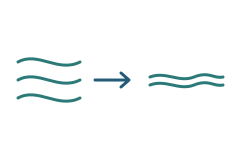
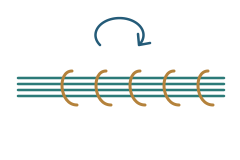
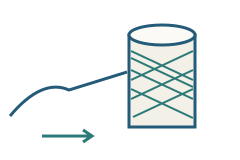
Air-jet spinning forms staple-fiber yarn by drafting a fiber strand and using swirling air to wrap fibers around a central fiber bundle. The core and its surrounding wrappers have different roles in holding the yarn together.1
Air-jet, vortex and proprietary names
Air-jet spinning and vortex spinning are related terms, but their meaning needs context. Basal and Oxenham describe vortex spinning as a refinement of jet spinning, while comparing an MJS air-jet system with an MVS vortex system as distinct technologies. In that usage, air-jet identifies the particular system being compared, rather than every development that uses swirling air.2
VORTEX is Murata Machinery’s name for its spinning machine and the yarn produced on it. Keep that proprietary label attached to Murata’s system; it should not replace the generic process name in every description.3
From sliver to a yarn package
The feed is sliver: an untwisted assembly of substantially parallel staple fibers that can be drafted.4 In the documented VORTEX process, it arrives after drawing.5
The essential sequence is:
- Draft the sliver. Roller drafting reduces its mass per unit length, producing a finer fiber strand for yarn formation.6
- Form the yarn with airflow. After the strand leaves the drafting rollers, swirling air forms the yarn structure. Wrapping fibers bind the central bundle.1
- Collect the yarn. The machine winds the yarn onto a package for subsequent use in weaving or knitting. Murata’s VORTEX outline places yarn-quality checking before package winding.56
In this process sequence, sliver feeds directly into spinning and the yarn leaves as a wound package. A separate roving step and a separate winding step are not required in the route described by CottonWorks.6
The core and wrapper structure
The core is the central bundle of substantially parallel fibers. Wrapper fibers wind around it and help bind the bundle. This arrangement is described as fasciated yarn structure.2
The shared core-and-wrapper description does not make every system’s yarn identical. In Basal and Oxenham’s study, wrapper formation in the air-jet system involved fibers at the strand edges; vortex spinning involved fiber separation around the bundle’s outer periphery. Their observations distinguish the wrapping arrangements, without providing a fixed recipe for every air-jet yarn.7
Use the structure to understand the process, rather than assuming a universal proportion of core fibers or wrappers.
Characteristics, uses and limits
CottonWorks identifies sheeting and print cloth as examples of air-jet yarn applications, and describes the wound package as suitable for subsequent weaving or knitting.6 These are representative uses, rather than a complete application list.
Murata highlights low hairiness as a characteristic of its VORTEX yarn. This is a manufacturer description of its own system, rather than a universal performance ranking for every air-jet yarn.3
Material compatibility also needs system context. Murata’s VORTEX documentation lists cotton, synthetic/cotton and synthetic material categories, while qualifying nozzle and spindle specifications by yarn type and the yarn-count range by fiber properties.5 A process label alone therefore does not establish which material or yarn specification a particular machine can handle.
Read an air-jet yarn description alongside its fiber composition and identified spinning system. The introductory mechanism explains how the yarn is formed; it does not establish a universal quality grade or an operating specification.
Related reading
See Spinning Fundamentals for the wider process context and Yarn Fundamentals for yarn form, construction, twist and fineness.
Citations
-
- Yarn Spinning — Cotton Incorporated / CottonWorks. Evidence locator: Air-Jet Spinning, roller-drafting and airflow paragraph.
- Vortex Spun Yarn vs. Air-Jet Spun Yarn — Association of Universities for Textiles (AUTEX) / De Gruyter · 2003-09-01. Evidence locator: printed p. 96 (PDF p. 1), Abstract and Introduction, and p. 99 (PDF p. 4), wrapper-formation discussion.
-
- Vortex Spun Yarn vs. Air-Jet Spun Yarn — Association of Universities for Textiles (AUTEX) / De Gruyter · 2003-09-01. Evidence locator: printed p. 96 (PDF p. 1), Abstract, Introduction and Experimental.
-
- About VORTEX — Murata Machinery, Ltd.. Evidence locator: What is VORTEX?; Features of VORTEX yarn; Feature 01 — Less hairiness.
-
- Terminology of Man-Made Fibres — International Bureau for the Standardization of Man-Made Fibres (BISFA) · 2017 Edition · 2017. Evidence locator: Chapter 3, SLIVER, printed p. 45 (PDF p. 45).
-
- About VORTEX Spinning Machine — Murata Machinery, Ltd.. Evidence locator: VORTEX spinning process; VORTEX spinning machine outline; Spinning zone; Main Specification, Material row and Notes 1–2.
-
- Yarn Spinning — Cotton Incorporated / CottonWorks. Evidence locator: Air-Jet Spinning, sheeting/print-cloth, input/package and roller-drafting paragraphs.
-
- Vortex Spun Yarn vs. Air-Jet Spun Yarn — Association of Universities for Textiles (AUTEX) / De Gruyter · 2003-09-01. Evidence locator: printed p. 99 (PDF p. 4), Results and Discussion, paragraph beginning The unique structures.