
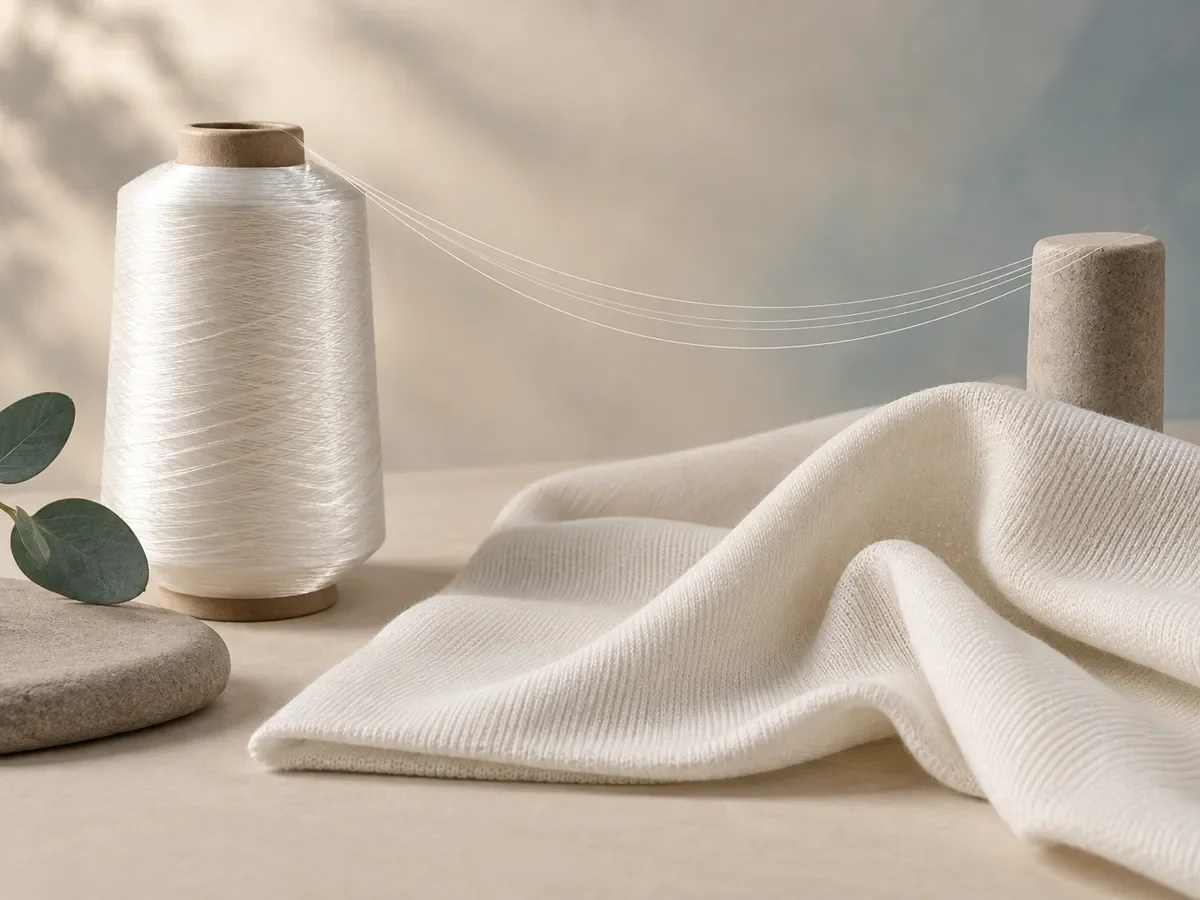



Elastane is a manufactured elastic fiber valued for its ability to extend and then recover toward its original length. In the United States, the same fiber type is usually called spandex. It is commonly combined with other fibers to give fabrics closer fit, easier movement, controlled stretch and improved shape response.12
Elastane is not a fabric name and it is not a guarantee of any one performance level. The behavior of a finished textile also depends on the elastane yarn form, the other fibers present, where the elastic component is placed, the fabric construction and the processing and care conditions.3
Elastane, spandex and LYCRA®
Elastane and spandex are generic names for the same fiber category. Elastane is the usual name in Europe, while spandex is used in the United States. For international content, “elastane (spandex)” is a clear first reference; either name may then be used according to audience and context.1
LYCRA® is different: it is a trademarked brand of elastane/spandex fiber. It should not be used as the generic name for every elastane fiber or every stretch fabric. A fabric that stretches does not, by that fact alone, establish either its fiber composition or the presence of a particular brand.1
What kind of fiber is elastane?
Elastane is a man-made synthetic fiber based on segmented polyurethane. Its formal generic definition combines this chemical identity with the ability to recover substantially after being stretched and released.4
It belongs to a different fiber category from rubber-based elastic thread. In textile classification, elastodiene covers fibers based on natural or synthetic polyisoprene, or related diene polymers; natural rubber is based on polyisoprene obtained from latex. Elastolefin is another separate elastic fiber category, made from partially cross-linked polymers based on ethylene and at least one other olefin. These materials may all provide elastic behavior, but their chemistry is not interchangeable.4
It is also important to separate fiber identity from fabric behavior. Elastane supplies elasticity as a constituent fiber. A textile can instead gain some stretch from the geometry of its yarns or fabric structure. Stretch observed in a finished product is therefore not enough to identify elastane without reliable composition information.4
Why does elastane stretch and recover?
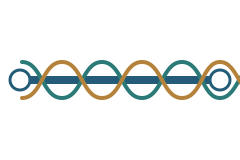
The polymer chains in elastane contain alternating flexible and rigid regions.
The flexible, or “soft,” segments allow substantial molecular movement when the fiber is pulled. The more rigid “hard” segments provide stabilizing points, add tensile support and limit permanent movement of the chains. When tension is released, the interaction between these regions helps draw the material back toward its earlier form.5
This explains the basic elastic mechanism, but it does not predict an exact stretch or recovery value for every textile. Once elastane is combined with other yarns and built into a fabric, the surrounding structure strongly affects how the finished material behaves.53
How elastane fiber is made
At a useful overview level, manufacture begins with preparing a long-chain segmented polyurethane containing the soft and hard regions needed for elastic behavior. The polymer is then formed into fiber by dry spinning or wet spinning.6
After fiber formation, the elastane is handled as yarn for use bare or in combination with other textile components. Exact chemistry, equipment, operating conditions and finishing sequences depend on the producer and process, so a generic fiber page should not present one detailed recipe as universal.62
How elastane is added to yarns and fabrics
Elastane may be used as bare yarn, but it is often combined with a relatively inelastic textile component. Common elastane-containing yarn forms include single- and double-covered yarn, core-spun yarn, core-twisted yarn, air-covered yarn and core-textured yarn.2
In these constructions, elastane generally provides the recoverable extension while the surrounding fiber or yarn changes the combined yarn’s form. Covering adds bulk and can improve the abrasion resistance of the elastic yarn. Other surface, handling and processing effects depend on the specific components and construction.2
Elastane can be combined with natural or synthetic fibers. In woven fabrics it may be placed in the warp, the weft or both directions. In knitted fabrics it may be introduced in courses or alternating courses. Placement controls the direction and character of stretch, while the other fibers and the fabric structure influence comfort, appearance and durability.2
The main function is not simply to make a textile feel stretchy. Elastane can help a fabric conform to a shape, move with the wearer, maintain a close fit or return toward its intended dimensions after extension.2
Key textile properties
The defining contribution of elastane is high extension followed by elastic recovery. This makes it useful where fit, freedom of movement, control or shape response matters.3
Other qualitative characteristics include:
- low moisture absorption;
- resistance to perspiration and cosmetic oils or lotions;
- dyeability and washability; and
- moderate, rather than unlimited, abrasion resistance.3
These are fiber-level tendencies, not guarantees for a garment or industrial component. A covered elastane yarn behaves differently from bare elastane. A woven construction can behave differently from a knitted one. Companion fibers, yarn arrangement, finishing, heat exposure, chemical exposure and use conditions all influence the final result.23
For that reason, generic figures for elongation, recovery, strength or service life are rarely enough to select a material. Product evaluation should use the actual yarn or fabric form and conditions relevant to its intended use.
Where elastane is used
Apparel
Elastane is widely used where comfort and fit depend on controlled stretch and recovery. Examples include sports and leisure wear, swimwear, hosiery and stockings, and foundation or corset fabrics. It also appears in garment components such as ribs, waistbands, shoulder straps, lace and narrow tapes, where conformity, positioning or shape retention is useful.7
The performance need differs by product. Active clothing needs freedom of movement and recovery. Hosiery and close-fitting garments need conformity and fit. Waistbands, straps and narrow goods often need stable positioning while accommodating movement.7
Non-apparel uses
Elastic conformity is useful beyond clothing. Documented application categories include medical tights, bandages, corsets, support products and sports tapes. In these products, support, fit or positioning can be central to the textile’s function.7
Elastane is also used in home and interior products such as bedding, covers, upholstery and furniture textiles, where size adaptability, surface conformity or stability may be useful. Selected lifestyle goods, accessories, advanced products and industrial components use stretch fiber for functions such as moldability or elastic positioning. Suitability still depends on the specific yarn and construction; one application example does not establish that every elastane yarn will perform the same way.7
Limitations, processing and care
Elastane-containing textiles require controlled handling. Important general cautions include:
- Heat: excessive heat can damage the elastic component and may contribute to yellowing. Heat exposure matters during manufacturing, ironing, washing and drying.
- Chlorine bleach: generic care guidance warns that chlorine can damage spandex/elastane.
- Light: prolonged exposure can contribute to yellowing in some products.
- Low moisture absorption: elastane itself absorbs little moisture; the behavior of a blended fabric therefore depends strongly on its other fibers and construction.
- Abrasion: resistance is limited, and yarn covering may be used to add protection.8
Wet processing—including relaxation, heat setting and dyeing—needs care because treatment of the elastic component and the surrounding fibers affects the finished structure. Processing conditions should be set for the actual fabric rather than copied from a generic fiber description.8
For consumers, the finished product’s care label or manufacturer’s instructions should take priority. Avoid treating a generic washing temperature or drying method as suitable for every elastane blend. Where no instructions are available, care decisions must also account for the main companion fiber in the textile.8
No universal promise of indefinite recovery can be made for repeated use. Long-term performance varies with yarn and fabric construction, processing, exposure and use. Numerical lifespan or cycle claims require evidence for a named product under defined test conditions.
Selection takeaway
Elastane and spandex are two names for the same segmented-polyurethane elastic fiber category. Its soft and hard polymer regions work together to provide extension and recovery, while textile construction determines how that behavior appears in a finished product.15
When evaluating an elastane-containing textile, look beyond the fiber name. Consider the yarn form, placement, companion fibers, fabric construction, processing history, expected exposure and care requirements. Those factors determine whether the material delivers the fit, movement, conformity and recovery needed for the application.
Related fiber guides
Citations
-
- Terminology of Man-Made Fibres — International Bureau for the Standardization of Man-Made Fibres (BISFA) · 2017 Edition · 2017. Evidence locator: Chapter 1, Section 1.1 and Section 1.3.
- The Scope of Textile Fibres — Royal Society of Chemistry · The Chemistry of Textile Fibres, 2nd ed.; Chapter 1; doi:10.1039/9781782620235-00001 · 2015-06-16. Evidence locator: Section 1.2.
- Quality (LYCRA®) — The LYCRA Company. Evidence locator: “What is the difference between LYCRA® fiber and spandex or elastane?” and “Is all fabric that stretches made with LYCRA® fiber?”.
-
- Terminology of Man-Made Fibres — International Bureau for the Standardization of Man-Made Fibres (BISFA) · 2017 Edition · 2017. Evidence locator: Chapter 2, Section 2.5, and related Chapter 3 yarn definitions.
- Elastane — CIRFS — European Man-made Fibres Association. Evidence locator: “Properties and End-Uses”.
- Wet processing of stretchable or elastomeric textiles — Woodhead Publishing / Elsevier · Handbook of Stretchable and Elastomeric Textiles, Chapter 8, pp. 147-162; doi:10.1016/B978-0-323-91194-8.00007-5 · 2024. Evidence locator: Chapter 8 abstract.
-
- Elastane — CIRFS — European Man-made Fibres Association. Evidence locator: “Elastane” and “Properties and End-Uses”.
- Understand Your Fibers — University of Georgia Cooperative Extension. Evidence locator: “SPANDEX” row.
- Wet processing of stretchable or elastomeric textiles — Woodhead Publishing / Elsevier · Handbook of Stretchable and Elastomeric Textiles, Chapter 8, pp. 147-162; doi:10.1016/B978-0-323-91194-8.00007-5 · 2024. Evidence locator: Chapter 8 abstract.
- Terminology of Man-Made Fibres — International Bureau for the Standardization of Man-Made Fibres (BISFA) · 2017 Edition · 2017. Evidence locator: Chapter 2, Section 2.5.
-
- Terminology of Man-Made Fibres — International Bureau for the Standardization of Man-Made Fibres (BISFA) · 2017 Edition · 2017. Evidence locator: Chapter 1 classification diagram and Section 1.3, entries for elastane, elastodiene and elastolefin.
- The Scope of Textile Fibres — Royal Society of Chemistry · The Chemistry of Textile Fibres, 2nd ed.; Chapter 1; doi:10.1039/9781782620235-00001 · 2015-06-16. Evidence locator: Section 1.2 and Table 1.1.
-
- Terminology of Man-Made Fibres — International Bureau for the Standardization of Man-Made Fibres (BISFA) · 2017 Edition · 2017. Evidence locator: Chapter 1, Section 1.3, elastane entry.
- What's That Stuff? Spandex — Chemical & Engineering News / American Chemical Society · Chemical & Engineering News 77(7), 70; doi:10.1021/cen-v077n007.p070 · 1999-02-15. Evidence locator: article abstract.
-
- What's That Stuff? Spandex — Chemical & Engineering News / American Chemical Society · Chemical & Engineering News 77(7), 70; doi:10.1021/cen-v077n007.p070 · 1999-02-15. Evidence locator: article abstract.
- Wet processing of stretchable or elastomeric textiles — Woodhead Publishing / Elsevier · Handbook of Stretchable and Elastomeric Textiles, Chapter 8, pp. 147-162; doi:10.1016/B978-0-323-91194-8.00007-5 · 2024. Evidence locator: Chapter 8 abstract.
-
- Elastane — CIRFS — European Man-made Fibres Association. Evidence locator: “Properties and End-Uses”.
- What's That Stuff? Spandex — Chemical & Engineering News / American Chemical Society · Chemical & Engineering News 77(7), 70; doi:10.1021/cen-v077n007.p070 · 1999-02-15. Evidence locator: article abstract.
- Material Applications — Asahi Kasei Corporation. Evidence locator: “Material Applications” sections.
-
- Understand Your Fibers — University of Georgia Cooperative Extension. Evidence locator: “SPANDEX” row.
- Wet processing of stretchable or elastomeric textiles — Woodhead Publishing / Elsevier · Handbook of Stretchable and Elastomeric Textiles, Chapter 8, pp. 147-162; doi:10.1016/B978-0-323-91194-8.00007-5 · 2024. Evidence locator: Chapter 8 abstract and keywords.
- Quality (LYCRA®) — The LYCRA Company. Evidence locator: “How do I care for my garments with LYCRA® fiber?”.
- Elastane — CIRFS — European Man-made Fibres Association. Evidence locator: “Properties and End-Uses.”.