
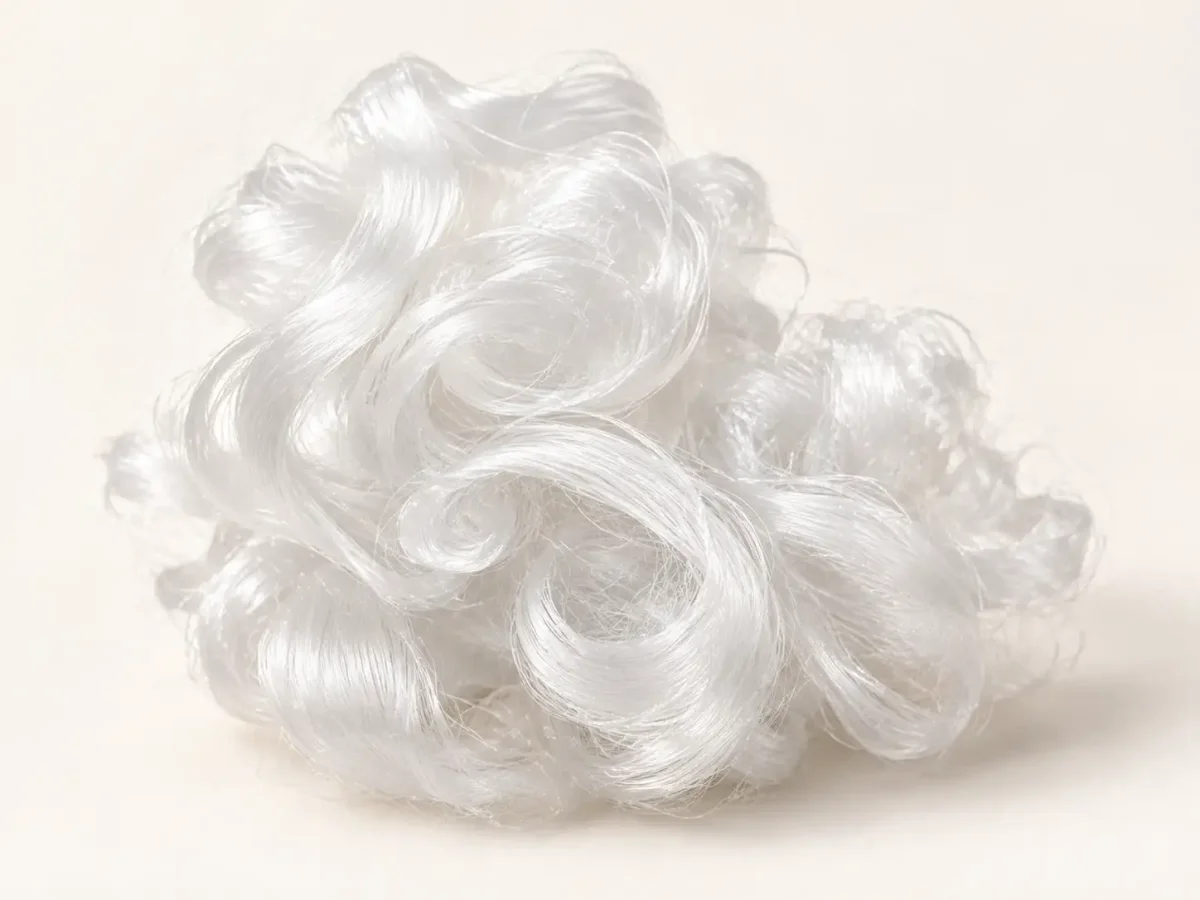
Polyester fiber is a man-made textile fiber defined by the chemistry of its fiber-forming polymer. In most everyday textile contexts, “polyester” refers to poly(ethylene terephthalate), usually abbreviated PET. PET is the principal practical case, but it is not the whole polyester family: other fiber-forming polyesters also exist.1
Polyester can be supplied as continuous filament or as staple fiber. Those fibers may then become yarns, fabrics, fillings, or nonwoven materials. This distinction matters because the performance of a finished textile depends on more than fiber chemistry alone. Polymer type, fiber form, processing, yarn and fabric construction, blending, and finishing can all change how a polyester product looks and behaves.1
What does “polyester fiber” mean?
In textile terminology, polyester is a generic fiber category. It identifies a class of man-made fibers whose linear polymer chains meet a defined chemical description. The term fiber describes the fine, flexible material unit from which later textile forms can be made.
Polyester fiber should not be used as a synonym for every polyester material. Polyester resins and other non-fiber polyester products sit outside this page’s textile-fiber scope. Nor are fiber, yarn, fabric, and garment interchangeable terms:
- A fiber is the basic fine material unit.
- A yarn is a long textile product composed of fibers, with or without twist.
- A fabric is a later textile structure made from fibers or yarns.
- A finished product combines the material with a particular construction, finish, design, and care requirement.
Keeping these levels separate prevents a common mistake: attributing every characteristic of a fabric or garment directly to polyester chemistry.2
Is polyester the same as PET?
Not exactly. Polyester names the wider fiber category, while PET names a particular polyester polymer. PET is the main polyester encountered in mainstream textile-fiber production, so the two terms are often used as if they were identical in ordinary commercial discussion.
That shorthand is useful only when the context is clear. Other fiber-forming polyesters, including PBT and PTT, have different polymer structures and can behave differently. A foundational description should therefore say that polyester textile fiber is commonly PET, not that every polyester fiber must be PET.1
Main fiber and yarn forms
Polyester reaches textile production in several related forms. The most important distinction is between continuous filament and staple fiber.
Continuous filament
A filament is a fiber of very great length that is treated as continuous. Filament yarn may contain one filament or many:
- Monofilament yarn contains a single filament.
- Multifilament yarn contains two or more filaments.
Filament yarns may be flat, twisted, interlaced, or textured. Texturing changes the form of a filament yarn to alter qualities such as bulk, elasticity, surface character, or handle. It does not change polyester into a different generic fiber.3
Tow and staple fiber
Tow is a large assembly of filaments held together without substantial twist, commonly as an intermediate material for the staple route. The tow can be drawn, crimped, and cut or otherwise converted into staple fiber—fiber of limited but spinnable length.
Staple fibers can be spun into yarn. They can also be used without yarn formation, including in filling and nonwoven applications. A yarn made from staple fibers is a spun yarn, usually held together by twist.
These distinctions describe material form and construction, not different base fiber identities. Continuous filament, textured filament yarn, tow, staple fiber, and spun yarn can all be polyester-based.4
Virgin and recycled polyester
The terms virgin and recycled describe feedstock history rather than a separate generic fiber family. Virgin polyester uses newly produced feedstock for the current manufacturing route. Recycled polyester uses recovered polyester or PET feedstock as an input.
The label “recycled polyester” does not by itself establish the product’s precise recycled content, quality, traceability, certification, or environmental performance. Those questions require separate evidence and are outside this foundational page.5
How polyester fiber is made
Polyester fiber production can begin with prepared polymer chips, or polymer production can feed directly into a continuous fiber-making process. For PET and related thermoplastic polyesters, the core sequence is:
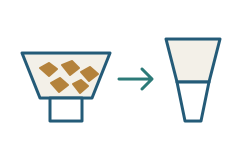
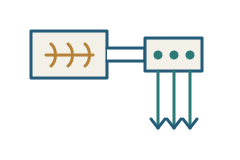
- Melting and extrusion. The polymer is melted and pushed through small spinneret openings, forming continuous strands.
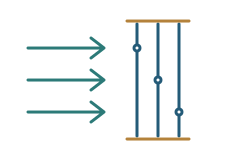
- Cooling or quenching. The emerging strands cool and solidify into filaments.
- Finish application. A spin finish may be applied to support handling and later processing.
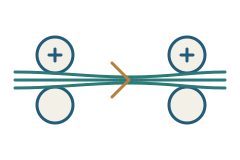
- Drawing. The filaments are stretched under controlled conditions. This develops molecular orientation and helps establish useful fiber properties.
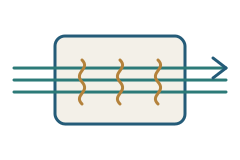
- Stabilization. Annealing or heat setting may be used to stabilize the internal structure and reduce unwanted dimensional changes.
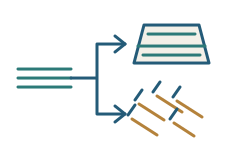
- Formation of the required product. Continuous filament can be wound as filament yarn. For staple fiber, filaments are assembled as tow and may be drawn, crimped, and cut. Filament yarn may also be textured when that form is required.
This is a schematic overview. Actual production routes vary with the polymer, equipment, intended fiber form, and required performance.6
General characteristics
Polyester is used across many textile sectors because it combines useful general characteristics with considerable manufacturing flexibility. At category level, polyester fibers are commonly associated with:
- useful strength;
- resistance to wrinkling and abrasion;
- dimensional or shape retention, particularly when heat setting is involved;
- resistance to damage from moths and mildew, with generally useful resistance to sunlight, weathering, and many chemicals; and
- the ability to be made in filament, staple, textured, blended, and nonwoven forms.
These points are tendencies, not universal specifications. Drawing and heat setting change molecular orientation and structure. Polymer choice, molecular weight, crystallinity, filament size, cross-section, texturing, additives, finishing, and the construction of the yarn or fabric can all alter performance.
For that reason, a category-level statement such as “polyester is strong” cannot replace a specification or test result for a particular fiber, yarn, fabric, or product. It also cannot establish comfort or suitability for an end use by itself.7
Common applications
Polyester appears in several broad application groups:
- Apparel, as both filament and staple-based textiles and in blends with other fibers. Polyester is commonly blended with fibers such as cotton and wool.
- Household and interior textiles, including constructed textile materials and filling applications.
- Industrial and technical textiles, including demanding yarn and fabric uses such as tire-cord materials.
- Fillings and nonwovens, where staple fiber or other fiber assemblies may be used without conventional yarn formation.
The available forms help explain this range. Continuous filament supports many yarn applications, staple fiber can be spun or used as loose filling, and polyester fibers can be engineered and processed for different structures. General strength, abrasion resistance, wrinkle resistance, and heat-set shape retention may contribute to suitability, but the relevant advantage depends on the finished product and its requirements.8
Limitations and handling
Polyester also has practical limitations. Depending on fiber design and textile construction, it can accumulate static electricity, attract lint, pill, or retain oily soils and odors. Fabric comfort cannot be predicted from fiber content alone. Structure, yarn form, fabric construction, finishes, and garment design also matter.
Excessive heat can soften or melt polyester. At the same time, controlled heat is used during manufacturing to establish or stabilize particular shapes and structures. This makes generic care rules unreliable: a safe treatment for one polyester product may not suit another construction, blend, finish, or design.
Always follow the care label on the finished product. Fiber identity provides useful context, but it does not replace product-specific washing, drying, pressing, or cleaning instructions.7
Key point
Polyester is best understood as a broad textile-fiber category whose principal mainstream polymer is PET. It can be made as continuous filament or staple fiber and developed into many yarn, fabric, filling, and nonwoven forms. Its familiar characteristics are shaped not only by polymer chemistry but also by fiber engineering and every later stage of textile construction.
Scope note
This introduction does not make numerical performance comparisons, sustainability conclusions, certification claims, legal-labeling interpretations, standards recommendations, or current market statements. Those subjects require separate evidence matched to a defined method, geography, date, standard, or rule.
Citations
-
- Terminology of Man-Made Fibres — International Bureau for the Standardization of Man-Made Fibres (BISFA) · 2017 Edition · 2017.
- Polyester — CIRFS — European Man-made Fibres Association.
- Melt-Spun Fibers for Textile Applications — Materials / MDPI · Materials 2020, 13(19), 4298; doi:10.3390/ma13194298 · 2020-09-26.
-
- Terminology of Man-Made Fibres — International Bureau for the Standardization of Man-Made Fibres (BISFA) · 2017 Edition · 2017.
-
- Terminology of Man-Made Fibres — International Bureau for the Standardization of Man-Made Fibres (BISFA) · 2017 Edition · 2017.
- Melt-Spun Fibers for Textile Applications — Materials / MDPI · Materials 2020, 13(19), 4298; doi:10.3390/ma13194298 · 2020-09-26.
-
- Terminology of Man-Made Fibres — International Bureau for the Standardization of Man-Made Fibres (BISFA) · 2017 Edition · 2017.
- Polyester — CIRFS — European Man-made Fibres Association.
-
- Polyester — CIRFS — European Man-made Fibres Association.
-
- Polyester — CIRFS — European Man-made Fibres Association.
- Melt-Spun Fibers for Textile Applications — Materials / MDPI · Materials 2020, 13(19), 4298; doi:10.3390/ma13194298 · 2020-09-26.
-
- Melt-Spun Fibers for Textile Applications — Materials / MDPI · Materials 2020, 13(19), 4298; doi:10.3390/ma13194298 · 2020-09-26.
- Understand Your Fibers — University of Georgia Cooperative Extension.
-
- Polyester — CIRFS — European Man-made Fibres Association.
- Melt-Spun Fibers for Textile Applications — Materials / MDPI · Materials 2020, 13(19), 4298; doi:10.3390/ma13194298 · 2020-09-26.
- Understand Your Fibers — University of Georgia Cooperative Extension.