
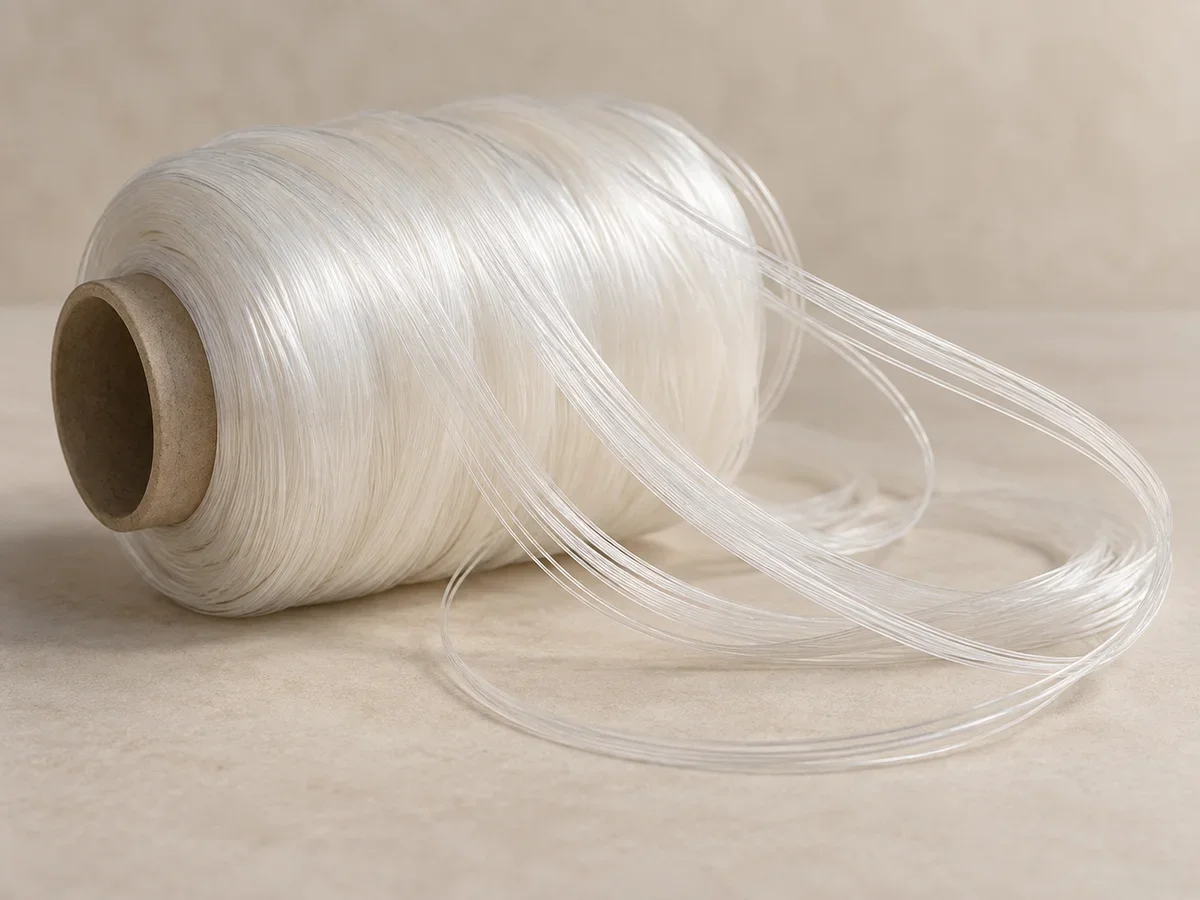
Polyamide is a broad family of polymers. In textiles, the familiar name nylon is commonly used for the conventional synthetic polyamide fibers represented especially by nylon 6 and nylon 6,6.1
Nylon fibers are valued for strength, toughness, abrasion resistance, elasticity, and resilience. Those tendencies help explain why nylon appears in products as different as hosiery, outerwear, carpets, ropes, airbags, and tyre reinforcement. They do not, however, guarantee how every nylon fabric will perform. fiber type, yarn form, fabric construction, finishing, and the way a property is tested all affect the result.
Polyamide and nylon: what is the difference?
Polyamide is the technical name for a class of polymers whose molecular backbones contain recurring amide linkages. The class is broader than the textile materials usually called nylon.1
For this introductory page, polyamide (nylon) fiber means the synthetic, fiber-forming polyamides commonly used as conventional nylon, principally polyamide 6 and polyamide 6.6. These may also be written as PA 6 and PA 6.6.
Not every polyamide belongs within that practical scope. Aromatic polyamides, commonly called aramids, are chemically part of the wider polyamide family but form a distinct textile category. Specialty polyamides also exist. Their properties should not be treated as one universal nylon-fiber profile.
The two principal textile types
Nylon 6
Nylon 6, or PA 6, is produced by ring-opening polymerization of ε-caprolactam. Its single number relates to the carbon count of the unit from which this aliphatic polyamide is formed.2
Nylon 6,6
Nylon 6,6, or PA 6.6, is produced by condensation of hexamethylenediamine and adipic acid. The two numbers correspond to the carbon counts of the diamine and diacid used to make the polymer.2
Both are important large-scale, melt-spun fiber materials. The distinction matters because they are different polymers with different production chemistry. A detailed performance comparison is not needed to understand the fiber family and should be based on specific grades, forms, and test conditions rather than the name alone.
How nylon fiber is made
The polymer must first be produced. Nylon 6 and nylon 6,6 follow different polymerization routes, but both can then be converted into fiber by melt spinning.2
A typical high-level fiber-forming sequence is:
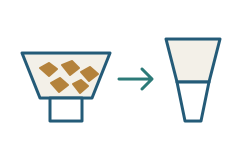
- Prepare the polymer. The polymer may arrive at the spinning line as chips or granules, or come directly from polymer production.
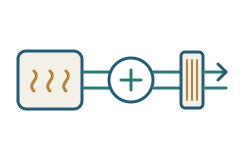
- Melt and pressurize it. Controlled heating turns the thermoplastic polymer into a processable melt.
- Meter and filter the melt. The flow is controlled and filtered before filament formation.
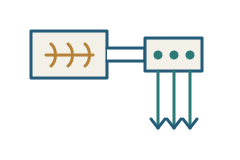
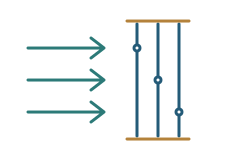
- Form the filaments. The melt passes through the small openings of a spinneret, producing continuous strands.
- Quench the strands. Cooling solidifies the newly formed filaments.
- Apply spin finish. A finish helps manage the filaments during later processing.
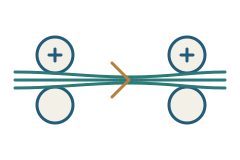
- Draw the filaments. Stretching between controlled rolls extends and aligns the polymer structure. Drawing is important because it develops the fiber’s tensile properties; it is more than a simple reduction in diameter.
- Stabilize and wind. Drawing may be followed by heat setting to stabilize the structure before the filament yarn is wound.
This sequence is a useful overview, not a fixed recipe for every plant or nylon product. Polymer choice and processing conditions influence the resulting fiber structure and properties.3
Filament, staple, and textured nylon
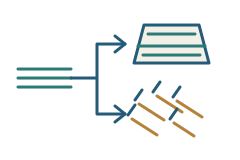
Melt spinning first produces continuous filaments, but those filaments can follow different routes.
- Filament yarn retains continuous filaments, which are gathered and wound for later textile manufacture.
- Staple fiber is made by assembling many filaments into tow, then stretching, crimping, and cutting them into shorter lengths for yarn or other textile production.
- Textured filament yarn is produced by adding a downstream texturing step to continuous multifilament yarn. Texturing introduces crimp and bulk and can change tactility, cover, appearance, insulation, and elastic response.3
Texturing is optional. It changes the geometry and behaviour of a yarn; it does not create the polymer’s intrinsic identity. A smooth flat-filament fabric, a textured-filament knit, and a staple-spun nylon fabric can therefore feel and behave quite differently even though all contain nylon.
Characteristic properties
Nylon 6 and nylon 6,6 fibers are commonly associated with several useful performance tendencies.4
| Characteristic tendency | Why it matters in textiles |
|---|---|
| Strength and toughness | Supports products that must withstand tension, repeated handling, or demanding use. |
| Abrasion and wear resistance | Helps in surfaces and structures exposed to rubbing. |
| Elasticity and resilience | Supports stretch, recovery, and resistance to lasting deformation. |
| Fatigue resistance | Helps where the material is repeatedly flexed or loaded. |
| Thermoplastic, heat-set behaviour | Allows fiber and yarn structure to be shaped and stabilized during manufacture. |
These are fiber-level characteristics, not finished-product specifications. “Nylon is abrasion resistant,” for example, is a useful starting point, but actual wear performance also depends on filament fineness, yarn construction, fabric structure, finishes, and the conditions of use and testing.
Limitations and practical cautions
The same material behaviour that enables nylon processing can create limitations in use.
- Heat sensitivity: Nylon is thermoplastic. Excessive heat can soften, melt, or fuse it, even though controlled heat can be useful for setting a textile structure.
- Relatively low moisture absorption: Nylon has relatively low moisture absorption in common consumer-textile contexts. Static buildup can also be a practical concern.
- Sunlight sensitivity: Strong or prolonged light exposure may reduce appearance or performance, depending on the product and its protection.
- Oily soil retention: Nylon can attract or retain body oils and oily soils, which may require attention during cleaning.
- Form-specific pilling: Pilling can occur in spun-nylon products; it should not be described as identical across all filament and staple constructions.5
Care advice must be product-specific. fiber type is only one part of a textile article, alongside colour, blends, construction, finishes, trims, and product design. The care label on the finished item should take priority over general fiber guidance.
Where nylon is used
Nylon appears in several major textile product groups.4
| Product group | Typical role of nylon |
|---|---|
| Hosiery and tights | Elasticity, resilience, and engineered filament-yarn structures. |
| Outerwear and knitted apparel | Strength, durability, recovery, and engineered yarn character. |
| Carpets | Resistance to wear and repeated surface abrasion, combined with suitable yarn construction. |
| Ropes | Toughness and resistance to repeated mechanical use. |
| Airbags and tyre reinforcement | Strength and fatigue-related performance in engineered technical structures. |
This range demonstrates nylon’s versatility, but the applications are not interchangeable. A hosiery yarn is designed around different requirements from a carpet yarn, rope, airbag fabric, or reinforcement cord.
Why “nylon fabric” is not a complete specification
A fiber name identifies the material family, not the whole textile. Finished performance emerges from several linked levels:
polymer and fiber → filament or staple form → yarn structure → fabric construction → finishing → product design
These choices influence properties such as stretch, recovery, stiffness, softness, surface friction, thickness, and abrasion behaviour. Textile evaluation likewise measures different behaviours separately and under defined procedures. A result for one nylon yarn or fabric should not automatically be projected onto another construction.6
When selecting or describing nylon, identify the level of the claim. A statement about fiber toughness is different from a tested claim about fabric abrasion, garment comfort, or product durability. Useful specifications therefore name the material form, construction, finish, intended use, and relevant test conditions whenever those details matter.
Key point
Polyamide is the broader polymer class; nylon is the familiar textile name for the conventional synthetic polyamide fibers discussed here. Nylon 6 and nylon 6,6 are the principal types in this introductory scope. Their characteristic strength, toughness, abrasion resistance, elasticity, and resilience explain many uses, while heat, moisture behaviour, static, sunlight, soiling, and construction-dependent performance require careful qualification.
Related fiber guide
Citations
-
- polyamide — International Union of Pure and Applied Chemistry · IUPAC Compendium of Chemical Terminology, 5th ed.; online version 5.0.0 (2025); source recommendation PAC 2009, 81, 1131 · 2025. Evidence locator: definition and Notes 1–2.
- Melt-Spun Fibers for Textile Applications — Materials / MDPI · Materials 2020, 13(19), 4298; doi:10.3390/ma13194298 · 2020-09-26. Evidence locator: Sections 1 and 2.2.
- Polyamide — CIRFS — European Man-made Fibres Association. Evidence locator: opening definition and introductory paragraphs.
-
- Melt-Spun Fibers for Textile Applications — Materials / MDPI · Materials 2020, 13(19), 4298; doi:10.3390/ma13194298 · 2020-09-26. Evidence locator: Section 2.2.
- polyamide — International Union of Pure and Applied Chemistry · IUPAC Compendium of Chemical Terminology, 5th ed.; online version 5.0.0 (2025); source recommendation PAC 2009, 81, 1131 · 2025. Evidence locator: Note 1.
- Polyamide — CIRFS — European Man-made Fibres Association. Evidence locator: introductory paragraphs identifying polyamide 6 and 6.6.
-
- Melt-Spun Fibers for Textile Applications — Materials / MDPI · Materials 2020, 13(19), 4298; doi:10.3390/ma13194298 · 2020-09-26. Evidence locator: Sections 4.1 and 5.1 and glossary.
- Polyamide — CIRFS — European Man-made Fibres Association. Evidence locator: “Production.”.
-
- Melt-Spun Fibers for Textile Applications — Materials / MDPI · Materials 2020, 13(19), 4298; doi:10.3390/ma13194298 · 2020-09-26. Evidence locator: Section 2.2.
- Understand Your Fibers — University of Georgia Cooperative Extension. Evidence locator: “NYLON” row.
- Polyamide — CIRFS — European Man-made Fibres Association. Evidence locator: “Properties and End-Uses.”.
-
- Understand Your Fibers — University of Georgia Cooperative Extension. Evidence locator: “NYLON” row, limitations and care columns.
- Melt-Spun Fibers for Textile Applications — Materials / MDPI · Materials 2020, 13(19), 4298; doi:10.3390/ma13194298 · 2020-09-26. Evidence locator: Sections 2.1 and 4.1.
-
- Melt-Spun Fibers for Textile Applications — Materials / MDPI · Materials 2020, 13(19), 4298; doi:10.3390/ma13194298 · 2020-09-26. Evidence locator: Sections 4.1 and 5.1.
- Kawabata Evaluation System — Wilson College of Textiles, North Carolina State University. Evidence locator: introductory description and measurement sections.