
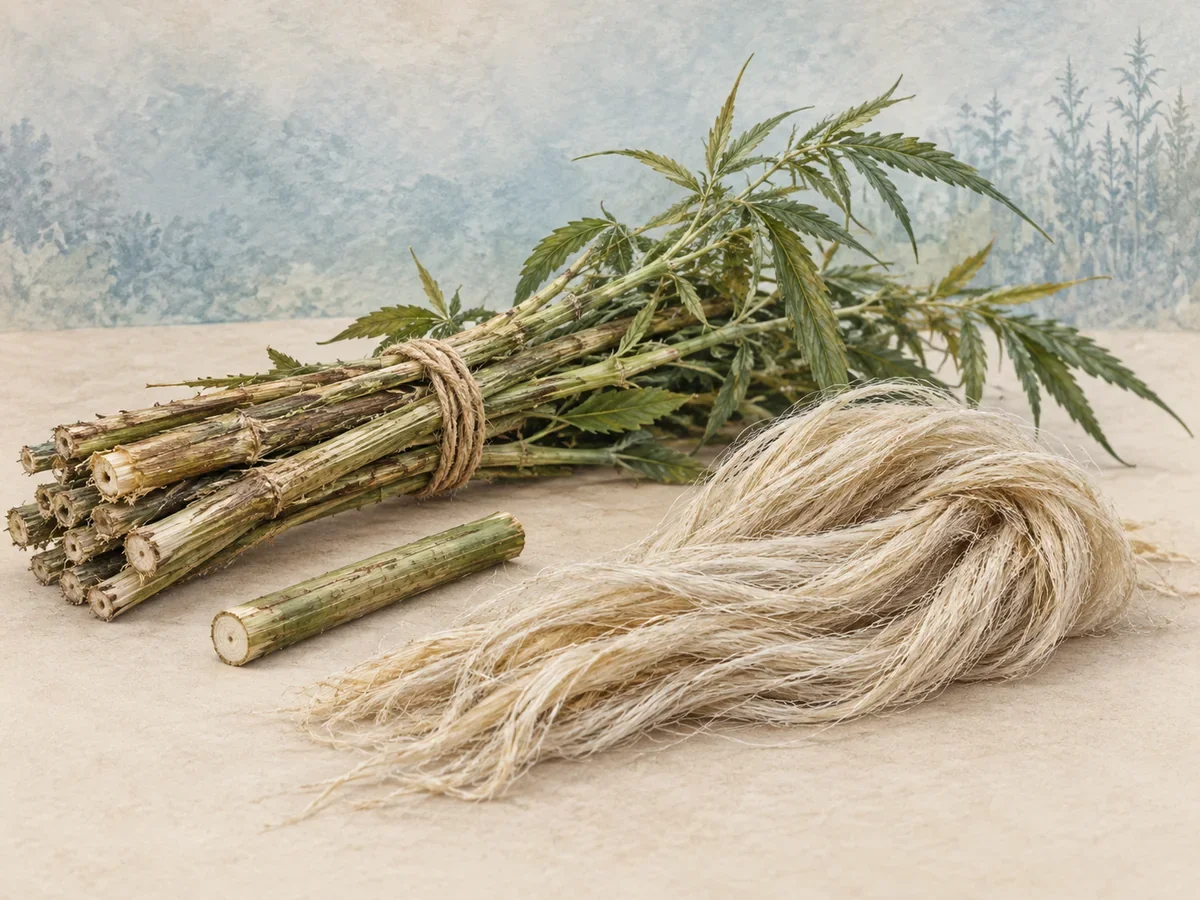
Hemp fiber is a natural plant fiber obtained from the stem of Cannabis sativa L. In textile use, it belongs to the group known as bast fibers: fibers found in bundles around the woody core of a plant stem. Those bundles can be prepared in different ways to produce long aligned fiber, shorter staple, tow, yarn, fabric, or nonwoven material.1
This variety of forms is central to understanding hemp textiles. “Hemp fiber” does not describe one uniform industrial input. Its behavior depends on the plant material, the way the fiber is separated and refined, the form supplied to a mill, and the spinning or fabric-making system that follows.
What is hemp fiber?
The accepted botanical name of the hemp plant is Cannabis sativa L., a species in the Cannabaceae family. The textile fiber comes from the bast region of the stem, outside the inner woody core commonly called hurd or shive. The bast region contains bundles of elongated fiber cells held together by pectin and other non-cellulosic materials.1
For this page, keep the following related objects distinct:
- the growing plant;
- the harvested stem;
- extracted bast fiber or fiber bundles;
- prepared fiber supplied for spinning or nonwoven production;
- yarn, fabric, or a finished textile containing hemp.
These are related, but they are not interchangeable. A property measured on extracted fiber does not automatically describe a finished fabric. Likewise, a fabric marketed as hemp may contain a blend rather than only hemp fiber.
This page treats industrial hemp only as a cultivation and industrial-use context, not as the botanical identity of the fiber. It does not define the term for legal purposes; it uses Cannabis sativa L. for botanical identity and hemp fiber for the textile material.
Key hemp-fiber terms
Bast fiber
A stem fiber located around the woody core. Hemp, like flax, is processed to separate this fiber-rich outer region from the rest of the stem.
Elementary fiber and technical fiber
An elementary fiber is an individual fiber cell. A technical fiber, or fiber bundle, is a group of elementary fibers that remains bonded together after extraction. This distinction matters because the dimensions and mechanical behavior reported for a single cell can differ from those reported for a bundle.2
Retting
Retting loosens the fiber by breaking down pectin and other materials that bind the bast bundles to surrounding stem tissue and to one another. Retting can be performed through different biological, physical, or chemical routes. The important point for a general fiber page is its function: making separation possible without excessive damage.
Decortication
Decortication mechanically separates bast-rich fiber from the woody part of the stem. Decorticated material may still contain shive, gums, or fiber bundles that require additional cleaning and refining. Decortication alone does not guarantee a spinning-ready fiber.
Degumming and refining
Degumming and refining remove more of the non-cellulosic material that holds fiber cells and bundles together. The required degree of separation and softening depends on the intended spinning or nonwoven route.
Long fiber, line fiber, and tow
Long fiber, also called line fiber, is the long, aligned fraction prepared through scutching and hackling for flax- or linen-type processing. Tow is the shorter and less aligned fraction separated during long-fiber preparation. Tow may be used for coarser yarn or refined further for a short-staple route.3
Cottonized hemp
Cottonized hemp is hemp fiber that has been shortened, opened, cleaned, and refined toward dimensions suitable for cotton spinning equipment. Cottonization is a processing route, not a botanical fiber category. It allows hemp to enter common short-staple systems, often in blends with cotton.3
How hemp stems become textile fiber
There is no single processing sequence used for every hemp textile. A traditional long-fiber route and a cottonized short-fiber route may share early operations but diverge during preparation. A useful high-level sequence is:
- Harvest and stem preparation. Stems are collected and prepared for the chosen extraction route.
- Retting where required. Binding materials are broken down so bast fiber can separate from surrounding tissues.
- Mechanical separation and cleaning. Breaking or decortication separates bast-rich material from hurd; cleaning removes loose woody matter and debris.
- Preparation for a specific fiber form. Long fiber is scutched and hackled to remove unwanted material and align it. Shorter routes may use degumming, refining, opening, carding, and cottonization.
- Preparation for spinning. Fibers are aligned and formed into sliver or roving as required by the chosen system.
- Textile formation. Prepared fiber is spun into yarn and then woven or knitted, or it moves from carding to a nonwoven process without yarn spinning.4
Retting, decortication, degumming, and cottonization are related operations, but they do different jobs. Their order can vary. Some routes mechanically extract fiber without following the full traditional long-fiber sequence, while others retain length and alignment for linen-type spinning.
Fiber forms and spinning routes
The name of a fiber form is useful only when it is connected to the system that will process it.
| Fiber form | Main preparation characteristic | Typical textile route |
|---|---|---|
| Long or line fiber | Long and aligned after scutching and hackling | Flax/linen-type long-fiber processing; wet or dry spinning according to the target yarn |
| Semi-long, carded, or combed fiber | Shorter than line fiber but prepared with some alignment | Dry-spun routes related to flax or wool systems; pure-hemp or blended yarn where quality permits |
| Tow | Shorter, less aligned output from long-fiber preparation | Coarser yarn or further refining and cottonization |
| Cottonized short fiber | Shortened, opened, cleaned, and refined | Cotton-system ring or rotor/open-end spinning, commonly in blends |
| Cleaned cardable short fiber | Prepared for web formation rather than yarn | Nonwoven production |
These categories are pathways, not universal quality grades. A mill also needs to consider length distribution, fineness, cleanliness, alignment, residual shive or gum, and batch consistency. Material called “long fiber” or “cottonized fiber” may still be unsuitable if those characteristics do not meet the receiving process.5
Properties that matter in textile processing
Hemp fiber is a cellulose-rich lignocellulosic material. Alongside cellulose, it contains varying amounts of hemicellulose, lignin, pectin, waxes, and other constituents. Cellulose contributes to strength, moisture interaction, dyeability, and chemical reactivity. Lignin and remaining binding materials contribute stiffness and can make fiber separation more difficult.6
The most useful properties to consider are not a single headline value but a connected set:
- length and length distribution, which affect alignment and spinning-system suitability;
- fineness and degree of separation, which affect yarn regularity and fabric hand;
- strength and tenacity, which influence how fiber withstands processing and loading;
- elongation and flexibility, which influence handling and response to stress;
- moisture sorption and surface condition, which influence wet processing and dyeing;
- cleanliness and residual non-fiber material, which affect processing stability and appearance.
Hemp is commonly characterized as strong and moisture-absorbing, but those descriptions are tendencies rather than guarantees for every yarn or fabric. Softness, drape, comfort, wrinkle behavior, abrasion performance, and durability depend on the prepared fiber, yarn design, blend, fabric construction, and finishing. A raw-fiber property should not be transferred directly to every product carrying a hemp label.6
Why hemp fiber varies
Natural hemp fiber is not intrinsically uniform. Its reported properties can change with:
- cultivar and plant material;
- growing and harvest conditions;
- plant maturity and position within the stem;
- retting method and degree;
- mechanical extraction and cleaning;
- degumming, refining, opening, and cottonization;
- damage introduced during processing;
- storage and handling;
- the fiber form, specimen preparation, and test method used for measurement.
Retting illustrates the balance required. If retting is insufficient, too much binding material remains and the fiber is difficult to separate. If retting goes too far, the fiber can be damaged or weakened. Field retting also depends on weather, which can increase variation between batches.7
Measurement language is equally important. An elementary fiber, a technical bundle, aligned line fiber, and cottonized staple are different specimens. Their length, fineness, and mechanical results should not be placed in one comparison without identifying what was measured and how. This is why context-free property tables can mislead even when the individual numbers came from published studies.
Hemp yarns, fabrics, and textile uses
Prepared hemp fiber can enter several manufacturing routes. Long aligned fiber can be handled through flax/linen-type systems. Semi-long fiber can be carded, combed, and dry spun. Cottonized material can enter cotton systems, while compatible preparations may enter systems related to wool. Depending on preparation quality and equipment, hemp can be spun alone or blended with fibers such as cotton or wool.8
Blending serves practical and design purposes: it connects a prepared hemp fiber to a workable spinning route and allows the yarn or fabric to be engineered as a combined material. The effect depends on the component fibers, blend proportion, spinning system, yarn structure, fabric construction, and finishing. A blend should therefore be assessed as its own textile rather than as a diluted version of a universal “hemp fabric.”
At a general page level, hemp textile applications include:
- woven and knitted apparel;
- home textiles;
- coarse yarns, cordage, and canvas-type textiles;
- carded nonwoven materials.
Hemp fiber is also used in technical and composite products, but those applications require their own material and performance context and are not covered here.8
Practical limitations
Consistency can be difficult to control
Variation in length, fineness, cleanliness, separation, and strength can make spinning less predictable and can produce uneven results between batches. Specifying the prepared fiber form is not enough; the mill also needs material that is consistent within the requirements of its process.
Long-fiber and short-fiber routes make different trade-offs
Long-fiber processing preserves length and alignment but depends on specialized flax/linen-type preparation and spinning equipment. Cottonization makes hemp accessible to widely used short-staple machinery, but it also shortens and further modifies the fiber. The result is a different balance of productivity, yarn uniformity, strength, and hand—not the same material placed on a different machine.9
Extraction quality affects feel and processability
Residual gum, lignin, shive, incomplete separation, or poorly controlled retting can contribute to coarse or stiff fiber and processing difficulty. A softer apparel textile depends on suitable refining, yarn design, blending where used, fabric construction, and finishing. “Hemp” alone does not specify the feel of the finished product.
Care is a finished-product question
There is no single care rule established here for all hemp textiles. Care guidance should be determined at finished-product level with its fiber blend, yarn and fabric construction, coloration, and finishes in view, rather than inferred from the fiber name alone.
How to interpret common hemp claims
Claims that hemp fabric is always stronger, softer, cooler, or more durable are too broad without information about the tested material and method. Claims about antimicrobial activity, UV protection, hypoallergenic performance, environmental superiority, certification, or legal compliance require separate evidence and a clearly defined product or jurisdiction. They are not established by the fiber name alone and are outside the scope of this page.
A more reliable evaluation starts with four questions:
- Which hemp fiber form was used?
- How was it extracted, refined, and spun?
- Is the textile pure hemp or a blend, and how is the fabric constructed and finished?
- Does the claim describe raw fiber, yarn, fabric, or the finished product?
Summary
Hemp is a stem-derived bast fiber from Cannabis sativa L. It reaches textile production through several possible preparation routes rather than one standard pathway. Long and aligned fiber can enter flax/linen-type systems; semi-long and tow fractions follow other carded or spun routes; cottonized hemp is prepared for short-staple equipment; and cleaned fiber can also be used in nonwovens.
The processing route is not a minor detail. It affects fiber separation, length, fineness, cleanliness, consistency, spinning suitability, yarn quality, fabric hand, and the meaning of performance claims. Understanding the prepared fiber form is therefore the most useful starting point for understanding any hemp textile.
Scope note
This introduction does not make numerical cross-fiber comparisons, sustainability or life-cycle conclusions, certification claims, legal interpretations, health-performance claims, or current market statements. Those subjects require evidence matched to a defined material, method, geography, date, standard, or rule.
Citations
-
- Cannabis sativa L. — Royal Botanic Gardens, Kew / Plants of the World Online · POWO accepted taxon record; accessed 2026-09-06. Evidence locator: taxon heading and Classification.
- Hemp Fibre Properties and Processing Target Textile: A Review — Materials / MDPI · doi:10.3390/ma15051901 · 2022-03-03. Evidence locator: Sections 2.1–2.2 and Figures 5–7.
-
- Hemp Fibre Properties and Processing Target Textile: A Review — Materials / MDPI · doi:10.3390/ma15051901 · 2022-03-03. Evidence locator: Sections 2.1–2.2.
-
- Hemp Fibre Properties and Processing Target Textile: A Review — Materials / MDPI · doi:10.3390/ma15051901 · 2022-03-03. Evidence locator: Sections 3–4 and Figures 16 and 18.
- Growing Hemp for the Future: A Global Fiber Guide — Textile Exchange · 2023 report · 2023-07-28. Evidence locator: Chapter 8, pp. 34–35.
-
- Hemp Fibre Properties and Processing Target Textile: A Review — Materials / MDPI · doi:10.3390/ma15051901 · 2022-03-03. Evidence locator: Sections 3–4 and Figures 16 and 18.
- Hemp: From Field to Fiber—A Review — Textiles / MDPI · doi:10.3390/textiles4020011 · 2024-04-12. Evidence locator: Figure 2 and retting/fiber-extraction discussion.
- Growing Hemp for the Future: A Global Fiber Guide — Textile Exchange · 2023 report · 2023-07-28. Evidence locator: Chapter 8, pp. 32–35 and Figure 13.
-
- Hemp Fibre Properties and Processing Target Textile: A Review — Materials / MDPI · doi:10.3390/ma15051901 · 2022-03-03. Evidence locator: Section 4 and Figure 18.
- Growing Hemp for the Future: A Global Fiber Guide — Textile Exchange · 2023 report · 2023-07-28. Evidence locator: Chapter 8, pp. 34–35.
-
- Hemp Fibre Properties and Processing Target Textile: A Review — Materials / MDPI · doi:10.3390/ma15051901 · 2022-03-03. Evidence locator: Sections 2.2–2.4.
- Hemp: From Field to Fiber—A Review — Textiles / MDPI · doi:10.3390/textiles4020011 · 2024-04-12. Evidence locator: fiber-properties discussion and Table 1, used qualitatively only.
-
- Hemp Fibre Properties and Processing Target Textile: A Review — Materials / MDPI · doi:10.3390/ma15051901 · 2022-03-03. Evidence locator: Sections 2.3 and 3.
- Hemp: From Field to Fiber—A Review — Textiles / MDPI · doi:10.3390/textiles4020011 · 2024-04-12. Evidence locator: retting and fiber-properties discussions.
-
- Hemp Fibre Properties and Processing Target Textile: A Review — Materials / MDPI · doi:10.3390/ma15051901 · 2022-03-03. Evidence locator: Introduction and Section 4.
- Growing Hemp for the Future: A Global Fiber Guide — Textile Exchange · 2023 report · 2023-07-28. Evidence locator: Chapter 8, pp. 32–35.
-
- Hemp Fibre Properties and Processing Target Textile: A Review — Materials / MDPI · doi:10.3390/ma15051901 · 2022-03-03. Evidence locator: Sections 2.3, 4, and 5.
- Hemp: From Field to Fiber—A Review — Textiles / MDPI · doi:10.3390/textiles4020011 · 2024-04-12. Evidence locator: retting and fiber-variability discussions.
- Growing Hemp for the Future: A Global Fiber Guide — Textile Exchange · 2023 report · 2023-07-28. Evidence locator: Chapter 8, pp. 32–35.