
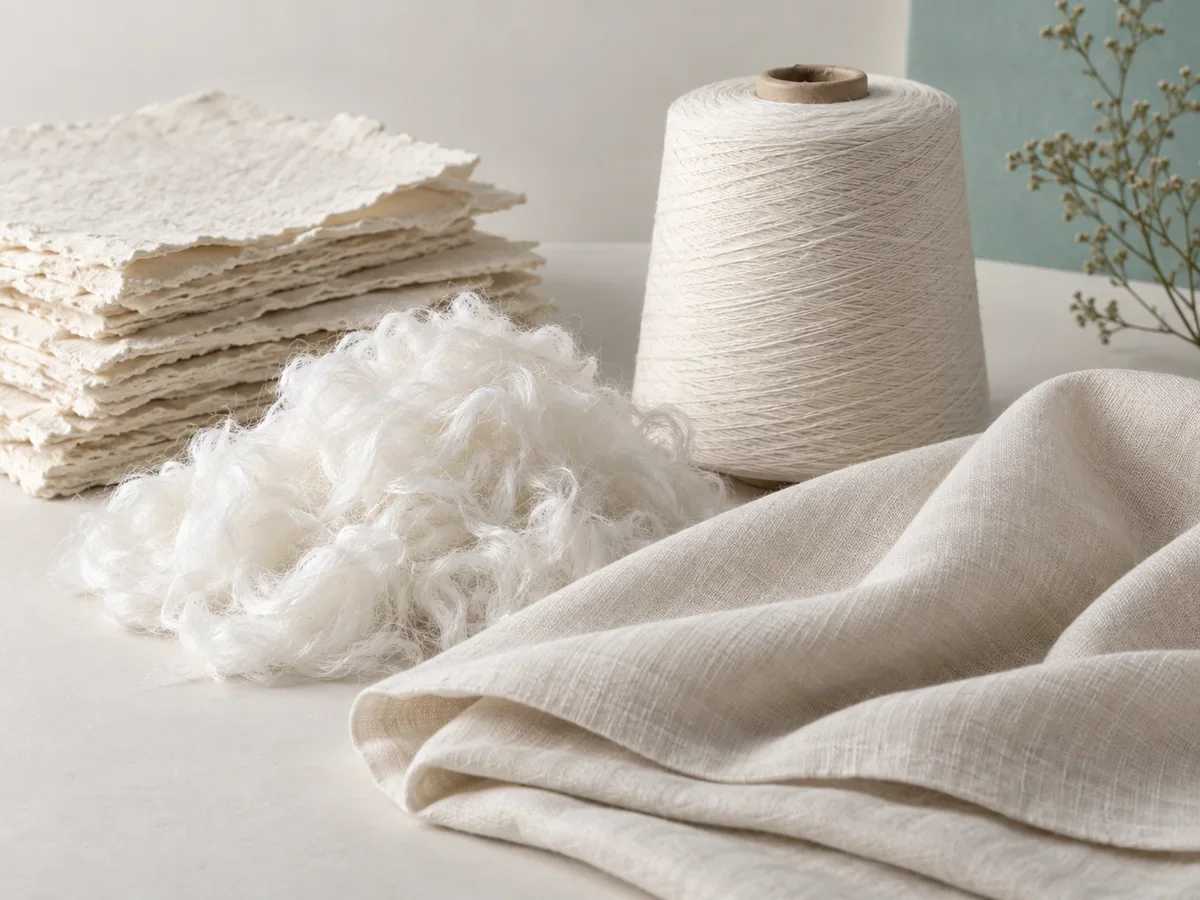
Lyocell is a manufactured cellulosic fiber made by dissolving cellulose and forming it again as fiber. It belongs to the same broad family of regenerated cellulosic fibers as viscose and modal, but it is defined by a different production route: the cellulose is dissolved and spun without first being converted into a cellulose derivative.1
Lyocell is the generic fiber name. It is not a brand name. TENCEL™ is a Lenzing AG trademark that can be used for branded lyocell or modal fibers, so “TENCEL” and “lyocell” should not be treated as interchangeable terms.2
At a glance
- Fiber family: manufactured cellulosic fiber
- Main raw material: commonly wood-based dissolving pulp; cotton linters are another established cellulose source
- Main solvent system: aqueous N-methylmorpholine N-oxide (NMMO)
- Fiber-forming method: dry-jet wet spinning
- Common characteristics: moisture absorbency, good dyeability, and relatively high dry and wet strength among regenerated cellulosic fibers
- Important processing issue: fibrillation under wet mechanical action
- Common uses: apparel, home textiles, towels, nonwovens, and selected technical products
What is lyocell?
Lyocell is a generic name for a cellulosic fiber obtained through an organic-solvent spinning process. In this context, solvent spinning means that cellulose is dissolved and then spun without forming an intermediate cellulose derivative. The finished fiber is regenerated cellulose: its fiber-forming substance is cellulose, even though the material has passed through dissolution and regeneration during manufacture.1
This classification separates lyocell from several nearby terms:
| Term | What it identifies |
|---|---|
| Lyocell | A generic cellulosic fiber made by an organic-solvent dissolution and spinning route without derivative formation |
| Viscose | A cellulosic fiber obtained by the viscose process |
| Modal | A separately defined cellulosic fiber characterized by high breaking force and high wet modulus |
| TENCEL™ | A Lenzing AG trademark used with branded fiber types, including lyocell and modal |
“Lyocell process” is also used in technical writing for the direct-dissolution production route associated with the fiber. This process use of the word does not make lyocell a trademark.2
What is lyocell made from?
Lyocell production begins with dissolving pulp rather than untreated plant material. Dissolving pulp is a purified cellulose feedstock prepared to contain a high proportion of cellulose and low levels of components that can interfere with dissolution or spinning. It is commonly wood-based, while cotton linters are another established cellulose source.3
Not every cellulose-bearing material is automatically suitable for commercial lyocell production. The pulp must have appropriate purity, molecular characteristics, and reactivity. Hemicellulose, ash, metal ions, and other residual components can affect how consistently the pulp dissolves and how stable the spinning solution remains. Mechanical preparation, chemical purification or bleaching, and other adjustments may therefore be used before fiber formation.3
The source material alone does not determine the performance of the finished textile. Pulp quality influences processing and fiber formation, while later spinning, yarn production, fabric construction, blending, dyeing, and finishing also shape the final result.
How is lyocell fiber made?
The conventional NMMO-based route can be described in six main stages.4
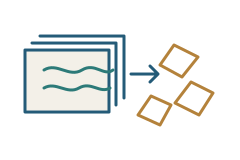
- Pulp preparation: Dissolving pulp is disintegrated and conditioned so that it can be mixed consistently with the solvent system.
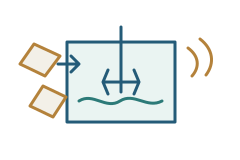
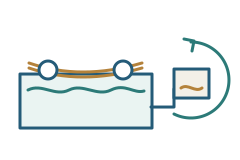
- Direct dissolution: The pulp is mixed with aqueous N-methylmorpholine N-oxide. Water is removed under controlled conditions until the cellulose forms a homogeneous, viscous spinning solution, often called the dope.
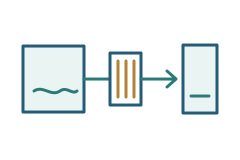
- Dope preparation: The spinning solution is filtered and prepared for stable extrusion.
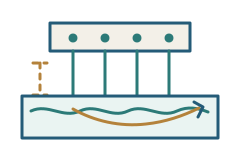
- Dry-jet wet spinning: The dope passes through fine spinneret openings, crosses an air gap, and enters an aqueous coagulation bath. In the bath, the dissolved cellulose precipitates or regenerates as continuous filaments.
- Washing and solvent recovery: The new fibers are washed to remove residual solvent. NMMO is recovered from the aqueous process stream for reuse.
- Finishing: The fibers are given the required post-treatment, dried, and either handled as filaments or cut for further textile processing.
The air gap is an important part of the fiber-forming stage. Stretching and orientation before coagulation help create lyocell’s dense, highly oriented fibrillar structure. Process variables such as pulp quality, dope condition, temperature, air-gap settings, spinning speed, and coagulation conditions can all influence spinning stability and the resulting fiber.4
How does lyocell behave in textiles?
At fiber level, lyocell is associated with a comparatively smooth surface, a dense fibrillar structure, and strong molecular orientation. These structural characteristics contribute to relatively high strength and modulus in both dry and wet states when compared with conventional viscose. Lyocell is also moisture absorbent and readily dyeable. It can contribute to textiles with a soft handle and good drape.4
These descriptions are tendencies, not guarantees for every product carrying a lyocell label. The feel and performance of a finished textile depend on more than its fiber content. Yarn structure, fabric construction, blend composition, surface characteristics, and finishing can change softness, roughness, drape, recovery, and perceived comfort.5
For this reason, claims such as “soft,” “strong,” or “comfortable” should be interpreted at the level of the actual fabric or product. A fiber name alone cannot describe the complete performance of a woven fabric, knit, nonwoven, blend, or finished garment.
What is fibrillation?
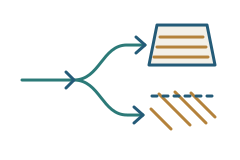
Lyocell contains fine fibrillar elements aligned mainly along the fiber length. Under wet abrasion or other mechanical action, some of these elements can separate from the body of the fiber and become exposed at its surface. This is called fibrillation.6
Visible fibrillation can change surface appearance and complicate wet processing. Its importance varies with the fiber variant and with the way the yarn or fabric is processed. Lyocell should therefore not be described as either universally fibrillating or universally resistant to fibrillation.
Fibrillation can be influenced during spinning and managed later through fiber selection and suitable dyeing or finishing routes. Reported control approaches include adjustments to spinning conditions, crosslinking treatments, selected reactive-dye treatments, and enzymatic finishing. These are manufacturing choices rather than universal instructions for every lyocell textile.6
Where is lyocell used?
Lyocell appears in a broad range of textile structures and end products. Common application groups include:
- apparel, including denim, casualwear, and underwear;
- home textiles and bedding;
- towels and absorbent textile products;
- nonwovens, including wipes and selected medical absorbent products; and
- selected filters, technical textiles, composites, and specialty papers.
These examples show the range of possible uses rather than a universal suitability list. Staple fibers, filaments, blends, nonwovens, and specially finished grades can have different processing requirements and performance. Product development should therefore begin with the intended construction and end use, not with the generic fiber name alone.6
Practical limitations and selection points
The most important lyocell-specific processing issue for an introductory page is fibrillation in wet conditions. Manufacturers need to match the fiber variant and processing route to the desired surface, while buyers should assess the actual fabric specification and finish rather than assuming that all lyocell textiles behave alike.6
Other practical considerations follow from the complete production and textile system:
- Pulp composition and consistency affect dissolution and spinning.
- Dope preparation and spinning conditions affect fiber structure and performance.
- Yarn, blend, construction, and finish influence the final textile’s handle and durability.
- Fiber-level properties do not replace product testing for a defined end use.
- Product-specific care instructions remain more useful than a universal rule based only on the word “lyocell.”
Lyocell is therefore best understood as a defined fiber category with characteristic production and structural features—not as a promise that every lyocell-containing product will have the same feel, performance, processing behavior, or care requirements.7
Citations
-
- Terminology of Man-Made Fibres — International Bureau for the Standardization of Man-Made Fibres (BISFA) · 2017 Edition · 2017.
-
- Terminology of Man-Made Fibres — International Bureau for the Standardization of Man-Made Fibres (BISFA) · 2017 Edition · 2017.
- TENCEL Branding Guideline Basics — Lenzing AG · Branding Guideline Basics.
-
- A Review on Raw Materials, Commercial Production and Properties of Lyocell Fiber — Journal of Bioresources and Bioproducts / KeAi Communications · Journal of Bioresources and Bioproducts 5(1), 16-25; doi:10.1016/j.jobab.2020.03.002 · 2020-02.
-
- A Review on Raw Materials, Commercial Production and Properties of Lyocell Fiber — Journal of Bioresources and Bioproducts / KeAi Communications · Journal of Bioresources and Bioproducts 5(1), 16-25; doi:10.1016/j.jobab.2020.03.002 · 2020-02.
- Regenerated Cellulose by the Lyocell Process, a Brief Review of the Process and Properties — BioResources · BioResources 13(2), 4577-4592 · 2018-03-13.
-
- Kawabata Evaluation System — Wilson College of Textiles, North Carolina State University.
-
- Regenerated Cellulose by the Lyocell Process, a Brief Review of the Process and Properties — BioResources · BioResources 13(2), 4577-4592 · 2018-03-13.
-
- Kawabata Evaluation System — Wilson College of Textiles, North Carolina State University.
- A Review on Raw Materials, Commercial Production and Properties of Lyocell Fiber — Journal of Bioresources and Bioproducts / KeAi Communications · Journal of Bioresources and Bioproducts 5(1), 16-25; doi:10.1016/j.jobab.2020.03.002 · 2020-02.
- Regenerated Cellulose by the Lyocell Process, a Brief Review of the Process and Properties — BioResources · BioResources 13(2), 4577-4592 · 2018-03-13.