
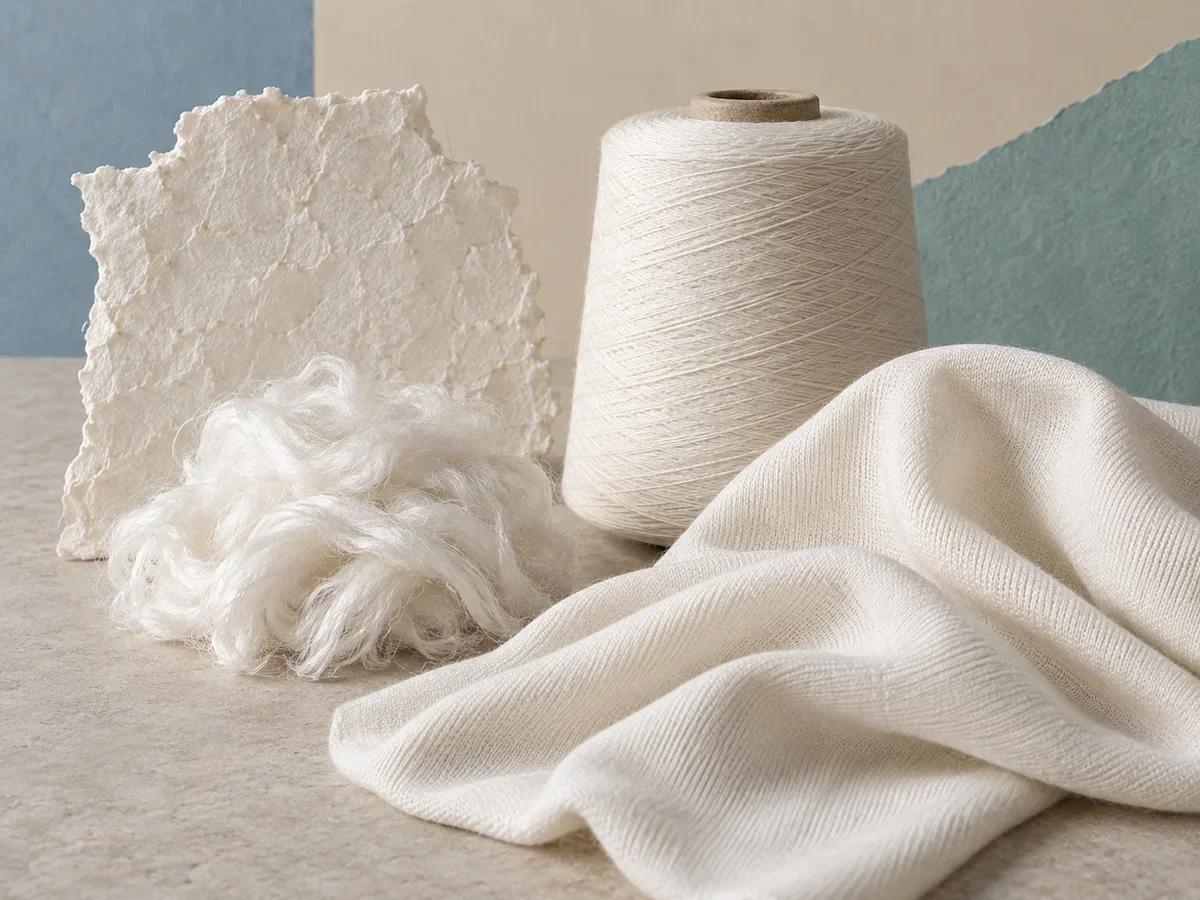

Modal is a manufactured cellulosic fiber made by regenerating cellulose through a modified viscose process. What distinguishes modal technically is not simply softness or a particular wood source: the category is defined by high breaking force and high wet modulus, meaning that the wet fiber resists extension under specified test conditions.1
This makes modal part of the regenerated-cellulose family, alongside viscose and lyocell, while giving it a more specific identity than the broad labels “rayon” or “viscose.” It is a fiber—not a fabric construction, finish, or brand.
Modal at a glance
- Material family: manufactured, regenerated cellulosic fiber
- Production route: a modified form of the viscose process
- Defining distinction: high breaking force and high wet modulus
- Common characteristics: soft hand, moisture absorbency, and stronger wet performance than conventional viscose
- Common uses: woven and knitted apparel, underwear, sportswear, and fiber blends
- Main caution: finished-fabric performance and care cannot be predicted from fiber name alone
What “modal” means
Technical definitions identify modal through its cellulose composition and performance under conditioned and wet testing. The International Bureau for the Standardization of Man-Made Fibres (BISFA) classifies it as a cellulose fiber with high breaking force and high wet modulus.1
Legal labeling language depends on jurisdiction. Under the current consolidated EU textile-fiber regulation, modal is a reserved name for regenerated cellulose fiber made by a modified viscose process and meeting defined breaking-force and wet-modulus criteria.2 Current U.S. Federal Trade Commission guidance lists Modal among the ISO fiber names permitted for use even though it is not separately named in the Textile Rules’ domestic list.3
These jurisdictional notes explain why labels and reference works may organize related cellulose fibers differently. They are not a substitute for checking the rules that apply to a particular product and market.
Generic name versus trademark
Modal is a generic fiber category. A trademark identifies a company’s branded offering and should not replace the generic fiber identity.
For example, TENCEL™ is Lenzing’s trademark for branded fibers and is used in names such as TENCEL™ Modal fibers and TENCEL™ Lyocell fibers. “TENCEL” therefore does not mean “modal” by itself; the generic fiber must still be identified.4 U.S. FTC guidance likewise distinguishes generic fiber names from fiber trademarks and requires trademarks to be used with the relevant generic name rather than in a misleading way.3
Modal, viscose, and lyocell
Modal, viscose, and lyocell all regenerate cellulose into textile fiber, but their names do not describe identical materials or processes.1
| Fiber | Defining route or distinction | Practical interpretation |
|---|---|---|
| Viscose | Cellulose fiber obtained by the viscose process | The broader conventional reference point for modal’s process and property comparisons |
| Modal | Cellulose fiber with high breaking force and high wet modulus; produced through a modified viscose route | Designed to retain stronger wet performance and greater dimensional stability than conventional viscose |
| Lyocell | Regenerated cellulose formed through dissolution and spinning in an organic solvent without forming a cellulose derivative | A different production route; it should not be treated as another name for modal |
This is a classification comparison, not a universal quality ranking. Fiber properties, yarn design, fabric construction, dyeing, finishing, and testing conditions all influence the behavior of the finished textile.
How modal is made
Modal begins with purified, dissolving-grade cellulose pulp. Beech wood is a common commercial source described in the technical literature, but the generic definition of modal does not require a particular tree species.5
At a useful high level, production follows these stages:
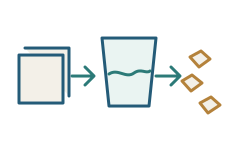
- Prepare the cellulose. Purified pulp is treated with sodium hydroxide to form alkali cellulose and is aged to control the polymer chain length.
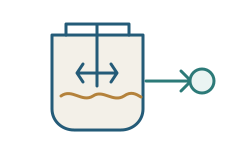
- Create a soluble intermediate. The alkali cellulose reacts with carbon disulfide to form cellulose xanthate, which is dissolved into the liquid known as viscose.
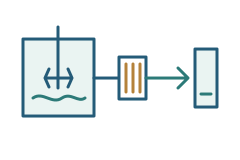
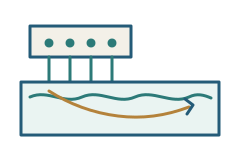
- Form the fibers. The viscose solution is extruded through spinneret holes into an acidic spinning bath, where cellulose is regenerated as fiber.
- Wash and finish. The regenerated fibers are washed, treated to remove process residues, finished, and prepared for textile use.
- Apply modal-specific controls. Compared with conventional viscose production, modal uses higher-degree-of-polymerization material and modified bath conditions or additives that permit greater molecular orientation and produce the required wet mechanical performance.5
This process description establishes how the fiber is made. It does not establish that one modal process has the same chemical recovery, emissions, forestry origin, or environmental performance as another.
Properties and practical limits
The strongest supported property statements are qualitative and comparative. Relative to conventional viscose, modal is associated with higher wet modulus, higher breaking strength in both wet and conditioned states, greater resistance to swelling and alkali, and better dimensional stability. The reviewed literature also describes modal as soft and moisture absorbent.5
| Characteristic | What can be said | What should not be assumed |
|---|---|---|
| Wet performance | Modal is defined to provide stronger resistance to force and extension when wet than conventional viscose. | Every modal fabric has the same wet strength or laundering durability. |
| Dimensional stability | Modal generally offers better dimensional stability than conventional viscose. | A garment is shrink-proof; construction and finishing still matter. |
| Softness | Soft hand is a commonly supported modal characteristic. | Fiber name alone determines fabric hand; yarn and fabric structure also contribute. |
| Moisture behavior | Modal is moisture absorbent. | Absorbency automatically proves cooling, drying speed, or comfort in every product. |
| Durability | Improved wet and conditioned strength can support more durable textile structures than conventional viscose. | Modal is universally pill-resistant, wrinkle-free, abrasion-proof, or longer-lasting. |
Modal should also not be assigned properties simply because they are associated with lyocell. The two fibers follow different production routes. In the reviewed literature, modal has lower crystallinity and thermal stability than lyocell, but those individual differences do not establish a universal winner for comfort, care, or product quality.5
Uses and blends
Modal is used in woven fabrics, underwear, sportswear, knitted materials, and blends with other textile fibers.5 Its soft hand and moisture absorbency help explain its use in garments worn close to the skin, while its wet strength and dimensional stability can offer practical advantages over conventional viscose. These are fiber-level tendencies, not guarantees for every product.
Modal appears both alone and in blends, but a blend must be evaluated as a finished material. The word modal on a content label identifies one constituent fiber; it does not describe the complete behavior of the yarn, fabric, or garment.
Care and handling
There is no single responsible washing instruction for every modal product. The safe care method depends on the complete item, including its blend, yarn and fabric construction, dyes, finishes, linings, trim, and other components.
Follow the finished product’s care label. Do not infer a wash temperature, bleach permission, drying method, or ironing temperature solely from the presence of modal. Safe care guidance depends on the complete product rather than modal content in isolation.6
Common misunderstandings
- “Modal” names a fiber, not a fabric. A modal textile may be knitted or woven and may contain other fibers.
- Modal is manufactured even when its cellulose comes from plants. The cellulose is chemically processed, dissolved, and regenerated into fiber.
- Modal is related to viscose but is not merely a marketing synonym for conventional viscose. Its high breaking force and high wet modulus are defining distinctions.
- Modal and lyocell are not interchangeable names. Their production-route definitions differ.
- TENCEL™ is not the generic name for modal. It is a trademark that can identify branded modal or lyocell fibers.
- Modal is not automatically “more sustainable.” Environmental comparisons require process-specific evidence, geography, time, method, functional unit, and system boundaries; this initial module does not make that comparison.
Citations
-
- Terminology of Man-Made Fibres — International Bureau for the Standardization of Man-Made Fibres (BISFA) · 2017 Edition · 2017.
-
- Regulation (EU) No 1007/2011 on textile fibre names and related labelling and marking of the fibre composition of textile products — European Union / EUR-Lex · Current consolidated version: 2018-02-15 · 2011.
-
- Threading Your Way Through the Labeling Requirements Under the Textile and Wool Acts — U.S. Federal Trade Commission · FTC business guidance; modal/ISO-name note updated October 2020; page edited January 2025 · 2014-07.
-
- TENCEL Branding Guideline Basics — Lenzing AG · Branding Guideline Basics.
-
- Dissolving-grade pulp: a sustainable source for fiber production — Wood Science and Technology / Springer Nature · Wood Science and Technology 58, 23-85 (2024); doi:10.1007/s00226-023-01519-w · 2024-01-10.
-
- Clothes Captioning: Complying with the Care Labeling Rule — U.S. Federal Trade Commission · FTC business guidance, May 2014 · 2014-05.