
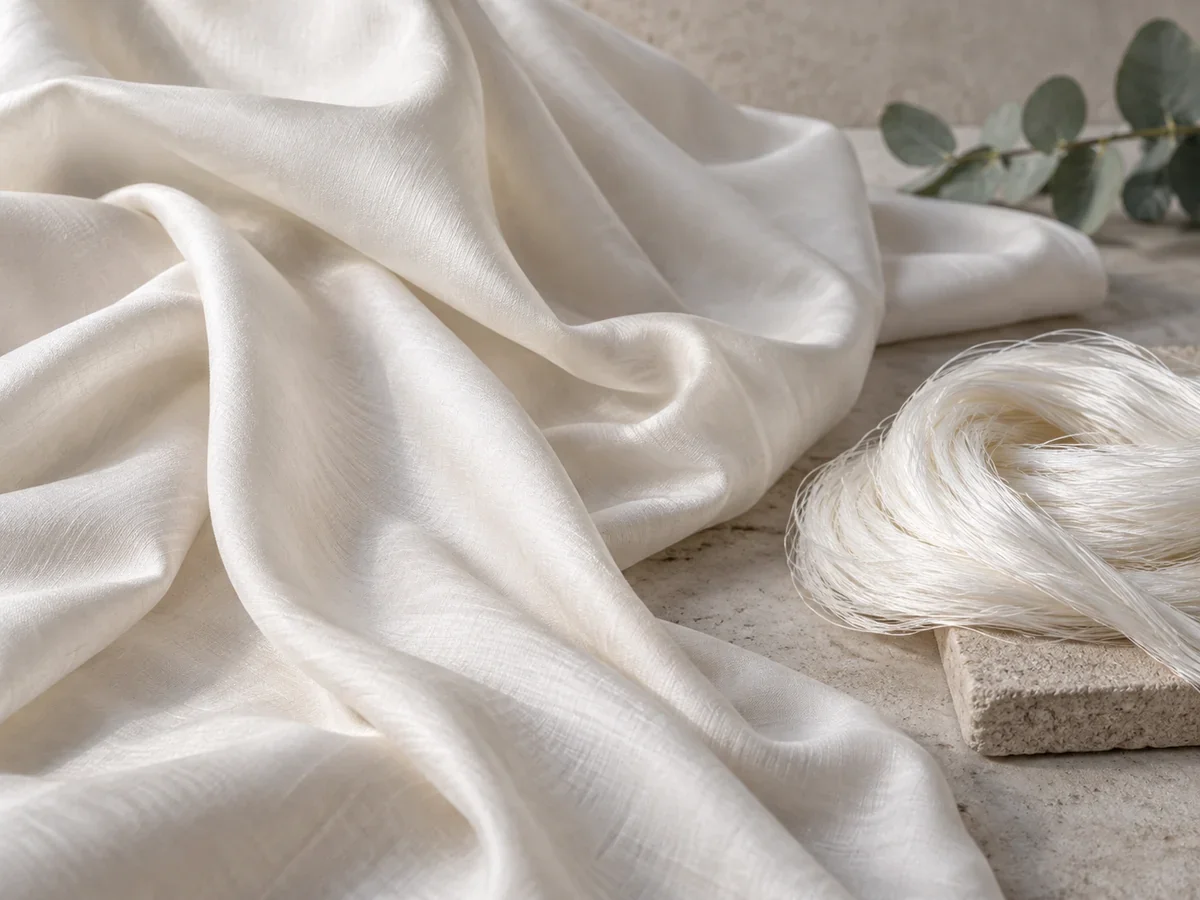
Viscose is a man-made cellulosic fiber produced by dissolving purified cellulose, shaping the resulting solution into filaments, and converting it back into cellulose. The fiber is also commonly called rayon, especially in the United States, while viscose is common in European usage. Viscose rayon is a useful combined name when the context could otherwise be unclear.1
Although its cellulose comes from plants, viscose is not a natural fiber in the same sense as cotton or flax. Its source polymer is natural, but the fiber itself is manufactured through dissolution and regeneration. For that reason, man-made cellulosic fiber and regenerated cellulosic fiber are the clearest broad classifications.2
Viscose, rayon, or viscose rayon?
In ordinary textile usage, viscose and rayon often identify the same cellulose-based regenerated fiber made by the viscose process. The preference varies with context: an established textile-chemistry reference gives viscose as the European name and rayon as the U.S. name for the same fiber type. BISFA, the international man-made-fiber standardization body, uses viscose as the generic name and defines it as cellulose fiber obtained by the viscose process.3
This naming pattern is useful for understanding product descriptions, but it should be treated as a usage pattern rather than a universal equivalence. The combined term viscose rayon is often the least ambiguous wording for a general technical explanation.
What is viscose made from?
Viscose begins with purified cellulose pulp from plant material. Wood pulp is the usual source described in the reviewed references, while cotton linters can also provide cellulose. The pulp is purified before it enters the fiber-making process.4
The process temporarily changes the cellulose into a soluble intermediate so that it can be filtered and shaped. In the spinning bath, cellulose is regenerated as solid fiber. The resulting fiber remains essentially cellulose, although processing changes its purity, physical form, molecular orientation, and degree of polymerization. Residual processing chemicals must be removed from the fiber.5
How viscose rayon is made
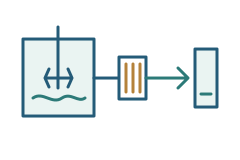
The viscose process can be understood as a sequence of preparation, dissolution, shaping, and regeneration.5
- Prepare the cellulose. Purified cellulose pulp is supplied as the starting material.
- Form alkali cellulose. The pulp is steeped in sodium hydroxide, then pressed, shredded, and aged.
- Make cellulose xanthate. The aged alkali cellulose reacts with carbon disulfide to form a soluble cellulose derivative.
- Prepare the viscose solution. The cellulose xanthate is dissolved in dilute sodium hydroxide. This solution is called viscose. It is ripened, filtered, and deaerated before spinning.
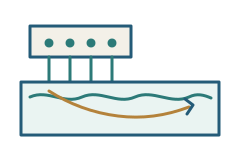
- Spin into a liquid bath. The viscose is forced through spinnerets—devices containing many small openings—into an acid spinning bath. This is a form of wet spinning.
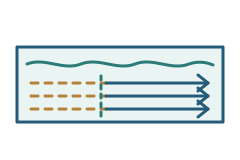
- Regenerate the cellulose. Reactions in the bath convert the soluble derivative back into cellulose, now shaped as fine filaments.
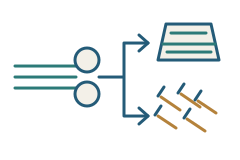
- Finish the fiber. The filaments are collected, stretched, washed to remove residual chemicals, finished, dried, and packaged. They may remain continuous or be cut into staple fiber.
This is a high-level process description. Individual production systems can differ, but detailed operating conditions are not necessary to understand the fiber’s identity or basic textile behavior.
Filament and staple forms
Viscose can be supplied as continuous filament or as staple fiber. A filament is a fiber of very great length that is treated as continuous. Staple fibers have a limited but spinnable length.6
The distinction matters because fiber form helps shape the resulting textile. Filament viscose can produce smooth, lustrous, fluid fabrics, including crepe types. Staple viscose can be spun alone or blended with other fibers to create a wider range of handles and appearances.4
Fiber form does not determine performance by itself. Yarn structure, fabric construction, blending, and finishing can all alter how a viscose product looks, feels, and behaves.
How viscose differs from related cellulosic fibers
Viscose belongs to a broader group of man-made cellulosic fibers, but the related names are not interchangeable.6
- Modal is a distinct cellulosic fiber category defined by high wet-modulus and breaking-force characteristics.
- Lyocell is a cellulosic fiber made by a solvent-spinning route that dissolves and spins cellulose without forming a cellulose derivative.
- Cellulose acetate is made by acetylating cellulose and is therefore chemically distinct from regenerated cellulose fibers such as viscose.
- Natural cellulosic fibers are not manufactured by dissolving and regenerating cellulose.
These distinctions establish the boundaries of viscose. They do not imply that one fiber is universally better than another.
Typical properties of viscose textiles
Viscose is valued for a combination of absorbency, dyeability, softness, and drape. Conventional viscose also has limitations that become especially important when the material is wet.7
| Typical fiber-level tendency | What it can mean in a textile | Important qualification |
|---|---|---|
| Absorbent and readily dyed | Can support comfortable-feeling, colored fabrics | Moisture behavior also depends on yarn, fabric, finish, and blend |
| Soft with good handle and drape | Suits fluid garments, linings, and decorative textiles | Filament and staple constructions can feel very different |
| Low elasticity or resilience | Can crease readily and may recover poorly from deformation | Finishes and blending can modify the result |
| Lower strength when wet | Wet textiles may be more vulnerable to stretching or damage during handling | The severity depends on the viscose type and product construction |
| Potential dimensional instability | Some products may shrink, stretch, or distort | Treatment, fabric structure, finishing, and care method are decisive |
| Limited abrasion resistance in some constructions | Repeated rubbing can reduce durability | Fabric density, yarn design, blends, and finishes affect wear behavior |
These are category-level tendencies, not specifications for every viscose product. Different yarns, constructions, finishes, and blends may behave differently even when all contain viscose.
Common uses
Viscose appears in apparel, linings, decorative textiles, and selected home-textile products. Supported examples include blouses, dresses, lingerie, linings, curtains, ribbons, and trims.4
The uses reflect several property relationships. Softness and drape suit garments that need fluid movement. Lustrous filament constructions can support smooth decorative surfaces and crepe fabrics. Absorbency, dyeability, and the ability to blend viscose staple with other fibers broaden the range of achievable colors, handles, and fabric effects.7
Suitability still belongs to the finished product, not the fiber name alone. Construction, yarn type, finishing, and blend composition must match the intended use.
Care and handling
There is no single safe care method for every viscose textile. Some products are washable, while others may carry instructions recommending dry cleaning. The product’s care label should therefore take priority over generic fiber advice.7
At fiber level, the most useful caution is that conventional viscose loses strength when wet. Wet garments and fabrics should therefore be handled gently. Whether a product can be washed, dried, pressed, or bleached safely depends on more than fiber content: the blend, fabric structure, finish, dye, and garment construction can all matter.8
Do not assume that two products with the same viscose percentage require the same treatment. Follow the instructions supplied for the finished item.
Key points
- Viscose rayon is a man-made, regenerated cellulosic fiber.
- Viscose and rayon often refer to the same fiber in ordinary usage, with regional naming preferences.
- The process dissolves purified cellulose, shapes it through spinnerets, and regenerates it as fiber.
- Viscose is available in continuous-filament and staple forms.
- Typical strengths include absorbency, dyeability, softness, and drape; typical limitations include creasing, lower wet strength, and possible dimensional change.
- Finished-product performance and care depend on construction, finish, blend, and other variables—not fiber content alone.
Related fiber guides
Citations
-
- Terminology of Man-Made Fibres — International Bureau for the Standardization of Man-Made Fibres (BISFA) · 2017 Edition · 2017.
- The Scope of Textile Fibres — Royal Society of Chemistry · The Chemistry of Textile Fibres, 2nd ed.; Chapter 1; doi:10.1039/9781782620235-00001 · 2015-06-16.
-
- Terminology of Man-Made Fibres — International Bureau for the Standardization of Man-Made Fibres (BISFA) · 2017 Edition · 2017.
- The Scope of Textile Fibres — Royal Society of Chemistry · The Chemistry of Textile Fibres, 2nd ed.; Chapter 1; doi:10.1039/9781782620235-00001 · 2015-06-16.
- Man-Made Fibres — WJEC · Textiles 1, Materials Resource 2 · 2017.
-
- The Scope of Textile Fibres — Royal Society of Chemistry · The Chemistry of Textile Fibres, 2nd ed.; Chapter 1; doi:10.1039/9781782620235-00001 · 2015-06-16.
- Terminology of Man-Made Fibres — International Bureau for the Standardization of Man-Made Fibres (BISFA) · 2017 Edition · 2017.
-
- Man-Made Fibres — WJEC · Textiles 1, Materials Resource 2 · 2017.
-
- Profile of the Plastic Resin and Manmade Fiber Industries — U.S. Environmental Protection Agency · EPA/310/R-97/006 · 1997-09.
-
- Terminology of Man-Made Fibres — International Bureau for the Standardization of Man-Made Fibres (BISFA) · 2017 Edition · 2017.
-
- Understand Your Fibers — University of Georgia Cooperative Extension.
- Man-Made Fibres — WJEC · Textiles 1, Materials Resource 2 · 2017.
-
- Understand Your Fibers — University of Georgia Cooperative Extension.