
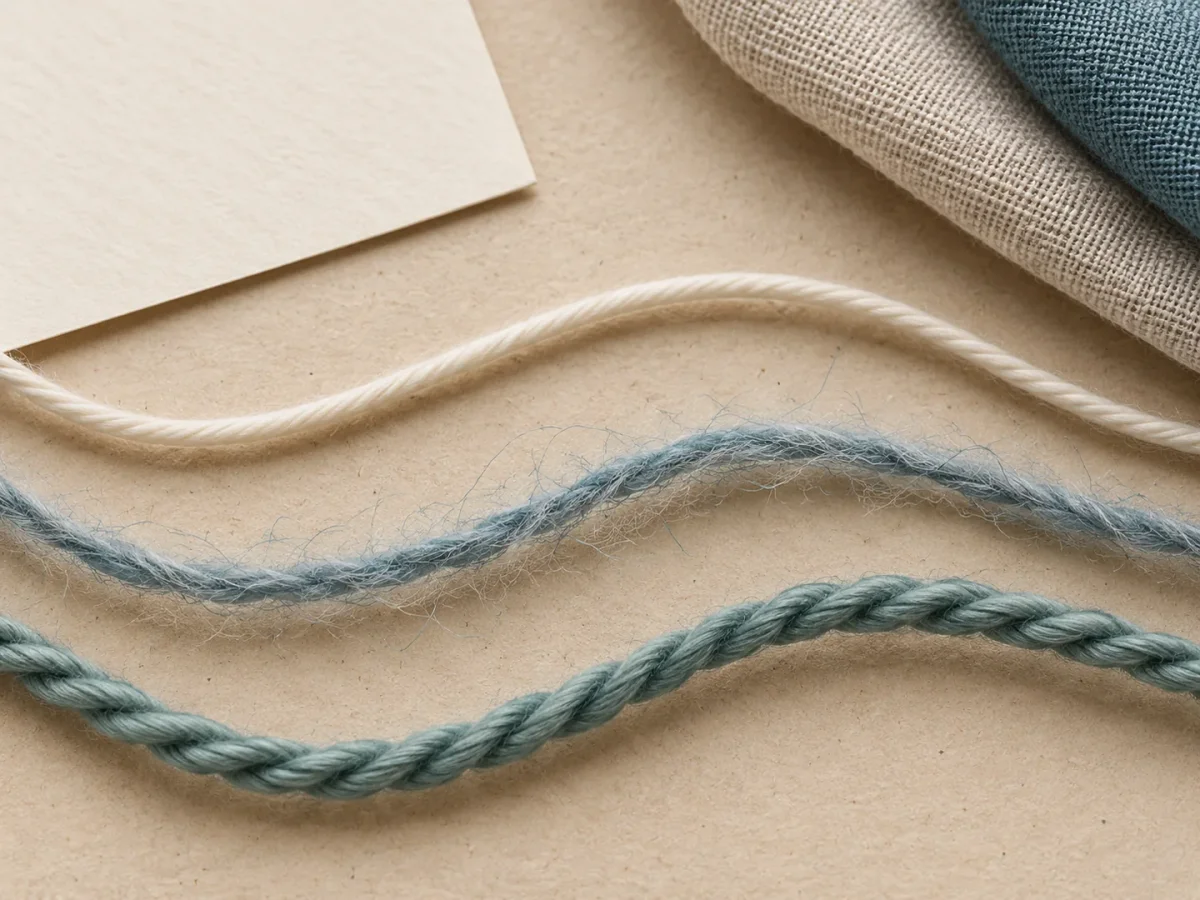
A yarn test report describes measurable characteristics. It does not, by itself, decide whether the yarn is suitable for a product. A property names what is being assessed; a result gives the measured value; a quality requirement sets the criterion for a stated use. A specification connects these by identifying the yarn, the test basis and the acceptable result.1
Identify the yarn first
Record its fiber composition, whether it is made from staple fibers or continuous filaments, and its construction—for example, a single or plied yarn. These descriptions matter because fiber characteristics and construction affect measured behavior. Compare results only after checking that the yarns and measurement conditions are comparable.2
Fineness and twist
Yarn count expresses fineness through a mass–length relationship. Linear density is mass per unit length; in the direct tex system, one tex means one gram per kilometre. Other count systems express the relationship differently. Give the system or unit with the number, and distinguish the count of a single strand from that of a plied yarn when relevant.3 For the numbering systems, see Yarn Count Systems.
Twist describes the spiral arrangement of fibers or strands. State its direction (S or Z) and its amount (turns per unit length); for plied yarn, say whether a value refers to the singles or the ply. Twist helps bind staple fibers, and an appropriate level depends on construction and use.4 See Yarn Twist for the fuller explanation.
Tensile behavior
Breaking force is the maximum force a yarn sustains during a tensile test before it breaks. Elongation at break tells how much it extends relative to its starting length, commonly as a percentage. Tenacity relates breaking force to linear density; it is not another name for the force itself.5
State which result is reported and the specimen and test conditions used. Fiber characteristics, construction and unevenness can affect the result. A force measured on unlike yarns or under unlike conditions does not support a simple quality ranking.56
Evenness and imperfections
Evenness describes how consistently yarn mass or linear density is distributed along its length. A mass-variation result summarizes that irregularity. Thin places and thick places identify local departures; neps are another category of counted imperfection. A report may therefore give both an overall variation measure and separate event counts. The counts depend on the reporting or detection settings, so check their basis before comparing them.7
Hairiness
Hairiness concerns fibers protruding from the yarn body. It describes the surface rather than mass variation along the strand. A reported hairiness index may be specific to the measuring instrument; its value needs that context. Its importance also depends on yarn construction and the intended use, so the value alone is not a pass/fail judgment.8
Read the results together
Start with the yarn description and intended use. Then read count and twist, tensile results, evenness and imperfections, and hairiness as different views of the same yarn. Check units, specimen or sample basis, conditioning and test method before comparing reports. Only a stated requirement or agreed specification turns a result into an acceptance decision; no single property is an overall quality score.169
Citations
-
- Textile quality management — Australian Wool Education Trust / Woolwise; CSIRO Textile and Fibre Technology. Evidence locator: printed p. 3, “Testing and quality management”; printed p. 7, “Specifications”.
-
- Textile Yarns — Cotton Incorporated / CottonWorks · Textile Yarns, January 2010, 35-page educational booklet · 2010-01. Evidence locator: §§1–2, printed pp. 2–3 and §7, pp. 24–25.
- Measurements of Yarn and Fabric — Australian Wool Education Trust / University of New England (Woolwise) · WOOL472/572 Wool Biology and Measurement, Topic 15 (2014), 19-page PDF · 2014. Evidence locator: §15.1, printed p. 15-6.
-
- Measurements of Yarn and Fabric — Australian Wool Education Trust / University of New England (Woolwise) · WOOL472/572 Wool Biology and Measurement, Topic 15 (2014), 19-page PDF · 2014. Evidence locator: §15.1 “Linear density (or count),” printed pp. 15-2–15-3.
- Textile Yarns — Cotton Incorporated / CottonWorks · Textile Yarns, January 2010, 35-page educational booklet · 2010-01. Evidence locator: §§6–7, printed pp. 23–25.
-
- Measurements of Yarn and Fabric — Australian Wool Education Trust / University of New England (Woolwise) · WOOL472/572 Wool Biology and Measurement, Topic 15 (2014), 19-page PDF · 2014. Evidence locator: §15.1 “Twist,” printed p. 15-3.
- Textile Yarns — Cotton Incorporated / CottonWorks · Textile Yarns, January 2010, 35-page educational booklet · 2010-01. Evidence locator: §5, printed pp. 21–22 and §7, pp. 24–25.
-
- Measurements of Yarn and Fabric — Australian Wool Education Trust / University of New England (Woolwise) · WOOL472/572 Wool Biology and Measurement, Topic 15 (2014), 19-page PDF · 2014. Evidence locator: §15.1 “Tensile properties of yarns,” printed pp. 15-6–15-8.
- Description of all quality parameters measured by Uster Technologies fiber and yarn testing equipment — Uster Technologies AG · Application Report SE 562, edition 4 (2014) · 2014. Evidence locator: §5, printed p. 15.
-
- Textile quality management — Australian Wool Education Trust / Woolwise; CSIRO Textile and Fibre Technology. Evidence locator: printed pp. 3–4, “Carrying out the test” and “Analysing the results”.
-
- Measurements of Yarn and Fabric — Australian Wool Education Trust / University of New England (Woolwise) · WOOL472/572 Wool Biology and Measurement, Topic 15 (2014), 19-page PDF · 2014. Evidence locator: §15.1 “Evenness,” printed pp. 15-4–15-5.
- Description of all quality parameters measured by Uster Technologies fiber and yarn testing equipment — Uster Technologies AG · Application Report SE 562, edition 4 (2014) · 2014. Evidence locator: §4.1, printed pp. 10–11.
-
- Description of all quality parameters measured by Uster Technologies fiber and yarn testing equipment — Uster Technologies AG · Application Report SE 562, edition 4 (2014) · 2014. Evidence locator: §4.3 “Hairiness of yarns,” printed p. 12.
- Textile Yarns — Cotton Incorporated / CottonWorks · Textile Yarns, January 2010, 35-page educational booklet · 2010-01. Evidence locator: §3.1, printed pp. 13–14.
-
- Textile quality management — Australian Wool Education Trust / Woolwise; CSIRO Textile and Fibre Technology. Evidence locator: printed p. 7, “Specifications”.
- Measurements of Yarn and Fabric — Australian Wool Education Trust / University of New England (Woolwise) · WOOL472/572 Wool Biology and Measurement, Topic 15 (2014), 19-page PDF · 2014. Evidence locator: §15.1, printed pp. 15-6–15-8.