
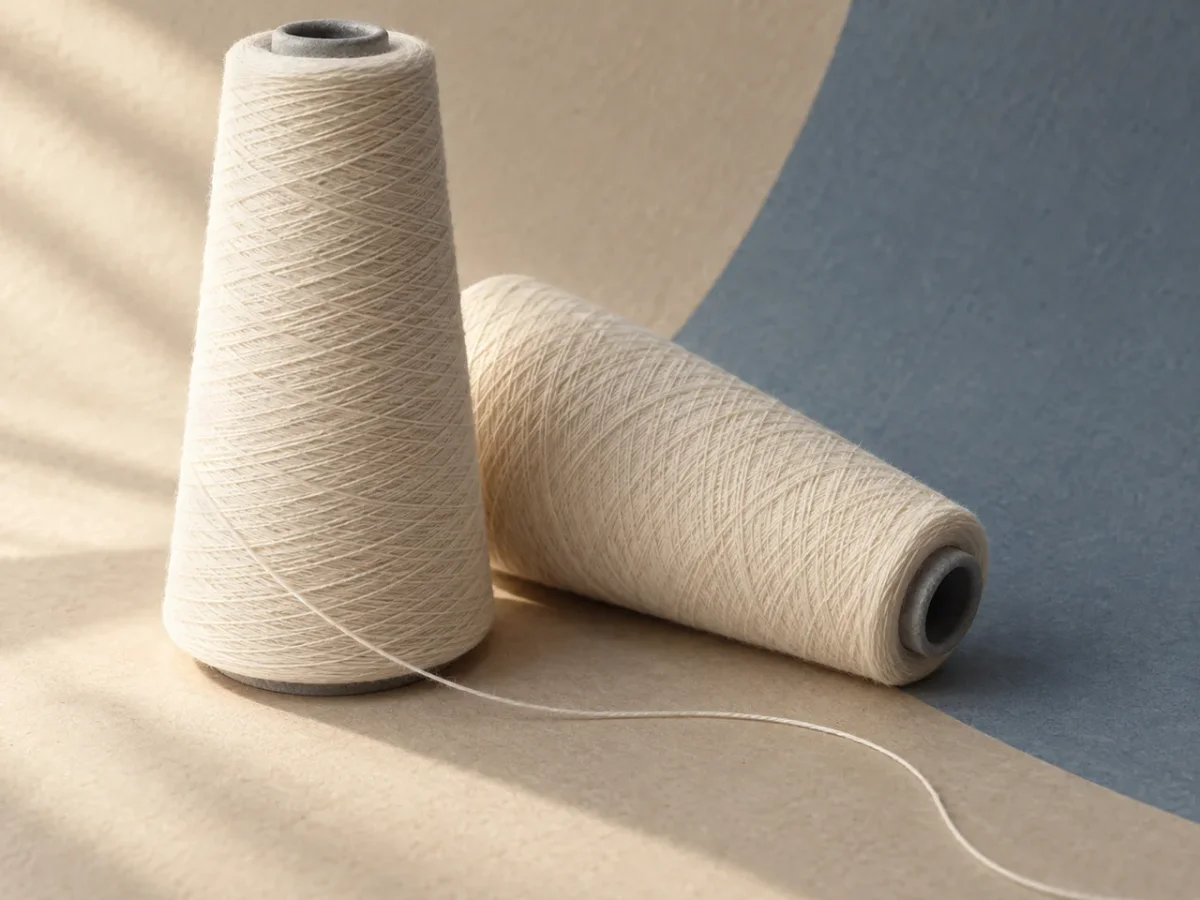


Compact-spun yarn is ring-spun yarn made with an additional fiber-condensing stage. Compact spinning brings the drafted fiber strand together before twist is inserted; it is a modification within ring spinning, rather than a separate fiber type.1 Here, “compact yarn” is shorthand for compact-spun yarn.
Compact, carded and combed
These words describe different parts of production. In a cotton example, carding aligns fibers into a strand called sliver. Combing adds preparation that removes short fibers. Carded and combed inputs can both supply ring spinning.2
Compact describes the subsequent spinning arrangement. Compact-spun cotton yarn can be produced from either carded or combed preparation, so “compact” does not automatically mean “combed.”2 Keeping the descriptors separate makes a yarn description easier to interpret.
How the process works
In conventional ring spinning, the delivered fiber ribbon converges into twisted yarn. The region between roller delivery and the point where the strand becomes twisted is called the spinning triangle. Fibers at its edges can be less fully incorporated into the yarn body.3
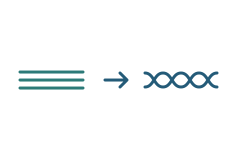
Compact spinning adds a condensing stage after the main drafting zone and before twist insertion. It narrows the fiber strand, reducing the spinning triangle and helping edge fibers enter the yarn body. This explains the process principle without implying that every protruding fiber disappears.3
Comparison with conventional ring-spun yarn
Controlled cotton experiments have found lower hairiness, a smaller measured yarn diameter and higher tenacity in compact-spun yarns than in their conventional ring-spun counterparts.4 Hairiness refers to fibers protruding from the yarn surface; tenacity expresses breaking force relative to yarn linear density.3
These are bounded observations, not a guaranteed improvement for every yarn. The comparison needs its fiber material, carded or combed preparation, yarn count, twist, equipment and measurement conditions. The cotton study varied preparation, count and twist, and used specified test conditions; its results should not be treated as an interchangeable specification for other yarns.4
Uses and limits
Demonstrated uses include cotton single-jersey knitting and compact-spun cotton weft in plain-weave fabric.5 These examples show that the yarn can enter both knitting and weaving routes.
The designation alone does not establish suitability for a particular product or guarantee its strength, appearance or comfort. This is a limit of what can be inferred from the label: the cited experiments evaluated particular yarn preparations and fabric constructions. Finished-fabric performance needs evidence for the fabric concerned.6
For the broader vocabulary, see Yarn Fundamentals. For preparation, drafting and spinning methods, see Spinning Fundamentals.
Citations
-
- Comparison of Conventional Ring, Mechanical Compact and Pneumatic Compact Yarn Spinning Systems — SAGE / Journal of Engineered Fibers and Fabrics · 2012. Evidence locator: Introduction, printed p. 87.
- Enhancing the quality of elastane-cotton core yarn by compact spinning — Elsevier / Heliyon · 2022-05-30. Evidence locator: Section 3.2, condensation mechanism paragraphs.
-
- Fiber Preparation for Spinning — Cotton Incorporated / CottonWorks. Evidence locator: Fiber Carding; Combing, first sentence; Roving, first paragraph.
- Comparison of Conventional Ring, Mechanical Compact and Pneumatic Compact Yarn Spinning Systems — SAGE / Journal of Engineered Fibers and Fabrics · 2012. Evidence locator: Experimental / Yarn Samples Production, printed p. 88.
-
- Enhancing the quality of elastane-cotton core yarn by compact spinning — Elsevier / Heliyon · 2022-05-30. Evidence locator: Section 3.2, paragraphs beginning “In conventional ring spinning”, “Resultantly full utilization”, “The compact yarn technology” and “The spun yarns”; Section 2.3, second paragraph; Section 3.3, first paragraph.
-
- Comparison of Conventional Ring, Mechanical Compact and Pneumatic Compact Yarn Spinning Systems — SAGE / Journal of Engineered Fibers and Fabrics · 2012. Evidence locator: Experimental, printed pp. 88–89; Yarn Hairiness Results, p. 92; Yarn Diameter Results, p. 93; Yarn Tenacity and Elongation Ratio Results, pp. 93–94; Conclusion, p. 99.
-
- Comparison of Conventional Ring, Mechanical Compact and Pneumatic Compact Yarn Spinning Systems — SAGE / Journal of Engineered Fibers and Fabrics · 2012. Evidence locator: Abstract, printed p. 87; Fabric Samples Production, p. 90.
- A Comparative Study between Physical Properties of Compact and Ring Yarn Fabrics Produced from Medium and Coarser Yarn Counts — Wiley / Journal of Textiles · 2014-11-23. Evidence locator: Section 2.1 Material, first two paragraphs.
-
- Comparison of Conventional Ring, Mechanical Compact and Pneumatic Compact Yarn Spinning Systems — SAGE / Journal of Engineered Fibers and Fabrics · 2012. Evidence locator: Experimental, printed pp. 88–90; paragraph following Table VIII, p. 97.
- A Comparative Study between Physical Properties of Compact and Ring Yarn Fabrics Produced from Medium and Coarser Yarn Counts — Wiley / Journal of Textiles · 2014-11-23. Evidence locator: Sections 2.1–2.2. The limitation is an editorial inference from the studies’ scope.