
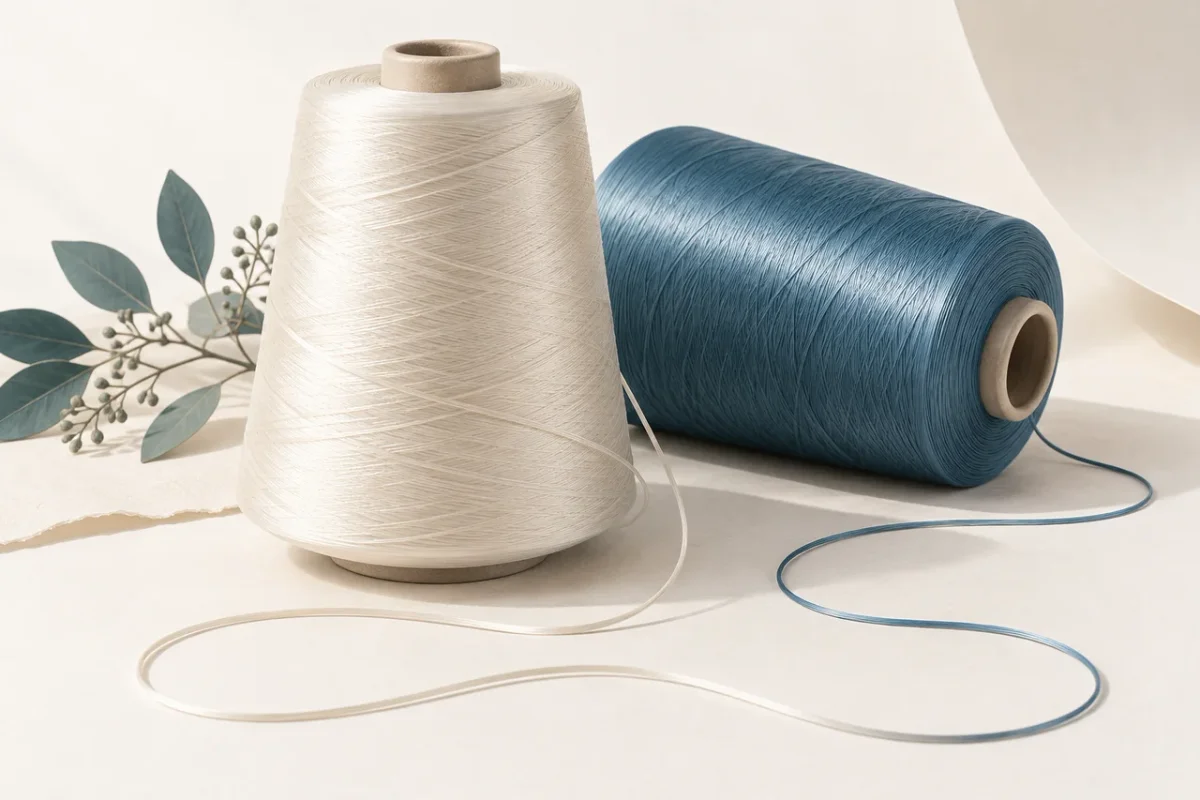



Filament yarn is yarn made from one or more continuous filaments. A filament is a fiber of very great length treated as continuous; staple-spun yarn instead assembles fibers of limited length. The distinction concerns fiber form, rather than whether the material is natural or manufactured.1
Reeled silk is a natural-filament example. Polyester is a manufactured example: it can remain in filament form or be cut into staple fibers for spun yarn.2 For the broader introduction, see Yarn Fundamentals.
Basic forms
Two descriptions help separate filament number from filament arrangement:
| Description | Meaning |
|---|---|
| Monofilament | A yarn consisting of one filament. |
| Multifilament | A yarn consisting of two or more filaments. |
| Flat or untextured | Filaments retain a relatively straight arrangement. |
| Textured | Filaments have, or can develop, crimp, coils or loops that provide bulk and/or stretch. |
The first pair describes filament number; the second describes arrangement. A multifilament yarn can be flat or textured. Filament yarns can also be twisted or untwisted: these descriptions are not mutually exclusive categories.3
Texturing changes filament arrangement while retaining filament form. A textured yarn does not necessarily offer both bulk and elastic stretch; its description needs to distinguish which effect is intended.4
How filament yarn is prepared
For manufactured polymer filaments, the starting material is brought into a fluid state and extruded through the small holes of a spinneret. This forms long, slender strands. The formation route depends on the polymer, so one process description does not apply to every material.5
Drawing stretches the filaments, making them thinner and increasing molecular orientation along their length. The filaments are collected for further processing; they may remain untextured or undergo texturing to change bulk and stretch characteristics. This is the conceptual sequence, rather than a set of manufacturing settings.5
Natural-filament preparation follows a different route. In silk reeling, filaments are unwound together from cooked cocoons in a warm-water bath, then the combined raw-silk thread is wound onto a reel. The operation gathers existing natural filaments rather than extruding a manufactured polymer.6 See Silk for the material context.
Reading a yarn description
Three descriptors answer different questions:
- Linear density: mass per unit length. Tex, dtex (decitex), and denier express this quantity on different scales.
- Filament count: the number of filaments in the yarn, distinct from its linear density.
- Twist: the helical arrangement of yarn components. Twist level describes turns per unit length; a filament yarn can also be untwisted.7
Read these alongside the flat/textured description. Together they identify aspects of yarn structure; this introduction does not decode complete specifications or supply quality limits.
Characteristics and uses
Flat filament yarn can provide a smooth, lustrous appearance. Texturing can add bulk and change stretch and feel. The changes help explain why filament yarn should not be assigned one fixed set of characteristics.8
Filament yarns are used in weaving and knitting. These are broad fabric-forming uses, rather than recommendations for a particular product.8 Material and processing details remain important: even the cross-section of a manufactured filament can change luster, texture and friction.9
For further orientation, Spinning Fundamentals explains the distinction between forming manufactured filaments and assembling staple fibers into yarn.
Citations
-
- Terminology of Man-Made Fibres — International Bureau for the Standardization of Man-Made Fibres (BISFA) · 2017 Edition · 2017. Evidence locator: Chapter 2, p. 21; Chapter 3, Filament and Filament yarn, p. 37.
-
- Silk Reeling and Testing Manual — Food and Agriculture Organization of the United Nations · FAO Agricultural Services Bulletin No. 136; ISBN 92-5-104293-4 · 1999. Evidence locator: Chapter 6, section 6.1.
- Textile Yarns — Cotton Incorporated / CottonWorks · Textile Yarns, January 2010, 35-page educational booklet · 2010-01. Evidence locator: sections 1.0–2.0, pp. 2–3.
-
- Terminology of Man-Made Fibres — International Bureau for the Standardization of Man-Made Fibres (BISFA) · 2017 Edition · 2017. Evidence locator: Chapter 3, Monofilament yarn and Multifilament yarn, p. 43; Filament yarn, p. 37.
- Textile Fibers — Cotton Incorporated / CottonWorks · Copyright 2013; 20-page educational booklet · 2013. Evidence locator: section 2.2.4, p. 9.
-
- Terminology of Man-Made Fibres — International Bureau for the Standardization of Man-Made Fibres (BISFA) · 2017 Edition · 2017. Evidence locator: Chapter 3, Textured filament yarn, p. 48.
- Textile Fibers — Cotton Incorporated / CottonWorks · Copyright 2013; 20-page educational booklet · 2013. Evidence locator: section 2.2.4, p. 9.
-
- Textile Fibers — Cotton Incorporated / CottonWorks · Copyright 2013; 20-page educational booklet · 2013. Evidence locator: section 2.2.4, p. 9.
-
- Silk Reeling and Testing Manual — Food and Agriculture Organization of the United Nations · FAO Agricultural Services Bulletin No. 136; ISBN 92-5-104293-4 · 1999. Evidence locator: Chapter 6, section 6.1, opening paragraph.
-
- Terminology of Man-Made Fibres — International Bureau for the Standardization of Man-Made Fibres (BISFA) · 2017 Edition · 2017. Evidence locator: Chapter 3, Linear density, p. 41; Twist and Twist level, pp. 49–50; Chapter 8, p. 78; Chapter 9, section 9.4 and Tables 9.5–9.6, pp. 86–88.
-
- Textile Yarns — Cotton Incorporated / CottonWorks · Textile Yarns, January 2010, 35-page educational booklet · 2010-01. Evidence locator: sections 1.0–2.0, pp. 2–3.
-
- Textile Fibers — Cotton Incorporated / CottonWorks · Copyright 2013; 20-page educational booklet · 2013. Evidence locator: section 2.2.6, p. 10.