
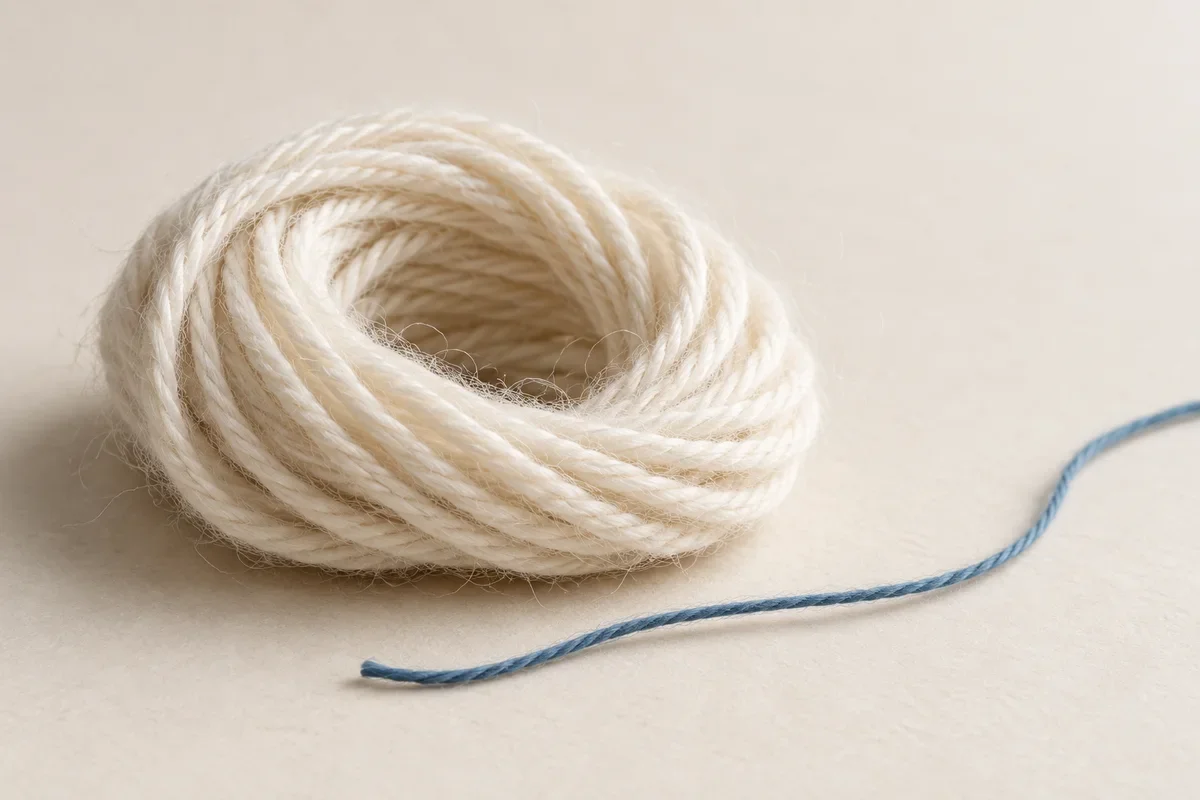
A core-spun yarn has a central strand surrounded by a sheath of staple fibers. The core and outer fibers are brought together during spinning, so the fibers become part of the spun yarn rather than being applied later as a separate, already formed cover yarn. A continuous filament is a common core, but the term does not specify one core material or one finished property.1
How the yarn is formed
In a ring-spun example, a core filament is fed toward the front of the drafting zone while a roving of staple fibers is drawn out. As the yarn forms, twist brings those fibers around the core to make the outer sheath. Core feeding can also be adapted to other spinning systems; the ring route is one way to explain the basic construction.2
What the components can do
An elastane (spandex) filament with a cotton-fiber sheath is one example. The elastic core is chosen to contribute stretch, while the cotton fibers form the yarn’s outer surface. Researchers have studied this construction for stretch denim. Its measured behavior still depends on how the yarn is made.3
A different example is a polyester-filament core surrounded by cotton or polyester staple fibers. Coats describes these constructions in corespun sewing threads; the core-spun yarns can then be plied into a finished thread. The example shows why “core-spun” describes a construction, not a synonym for “stretch yarn.”4
Core-spun and covered yarn
Both can show a core-and-cover arrangement. In the ring core-spun construction described here, the sheath forms from staple fibers during spinning. In the covered-yarn process described by Shi and colleagues, an outer filament is wound in a spiral around an existing core yarn. The distinction is how the outer component is supplied and attached. Because “wrapped” can describe more than one arrangement, the construction is more useful than the label alone.5
Reading a property claim
Two core-spun yarns need not behave alike. The core and sheath materials, their arrangement, and the spinning method can change the resulting yarn. In an elastane/cotton study, changing the spinning arrangement changed observed yarn structure and mechanical properties. A meaningful claim about stretch, strength, appearance, or durability therefore needs the particular construction and its evidence, rather than the category name alone.6
For broader context, see Yarn Fundamentals, Ring-Spun Yarn, and Elastane (Spandex).
Citations
-
- Enhancing the quality of elastane-cotton core yarn by compact spinning — Elsevier / Heliyon · 2022-05-30. Evidence locator: Introduction, opening paragraph.
- Thread Production — Coats Group plc. Evidence locator: “Core Spinning” and “Thread Types.”.
-
- Enhancing the quality of elastane-cotton core yarn by compact spinning — Elsevier / Heliyon · 2022-05-30. Evidence locator: Introduction, Figure 1 discussion.
- Thread Production — Coats Group plc. Evidence locator: “Ring Spinning” and “Core Spinning.”.
-
- The Scope of Textile Fibres — Royal Society of Chemistry · The Chemistry of Textile Fibres, 2nd ed.; Chapter 1; doi:10.1039/9781782620235-00001 · 2015-06-16. Evidence locator: Section 1.2, generic-name discussion and Table 1.1 (elastane/spandex naming).
- Enhancing the quality of elastane-cotton core yarn by compact spinning — Elsevier / Heliyon · 2022-05-30. Evidence locator: Introduction, paragraphs on elastane-cotton core yarn and its uses; Abstract and Conclusion.
-
- Thread Production — Coats Group plc. Evidence locator: “Core Spinning,” “Twisting of Spun and Corespun threads,” and “Thread Types.”.
-
- Thread Production — Coats Group plc. Evidence locator: “Core Spinning”.
- Development of a Small, Covered Yarn Prototype — AUTEX Research Journal / De Gruyter · 2023. Evidence locator: Sections 1–2.
-
- Enhancing the quality of elastane-cotton core yarn by compact spinning — Elsevier / Heliyon · 2022-05-30. Evidence locator: Abstract, Section 3 results, and Conclusion.