
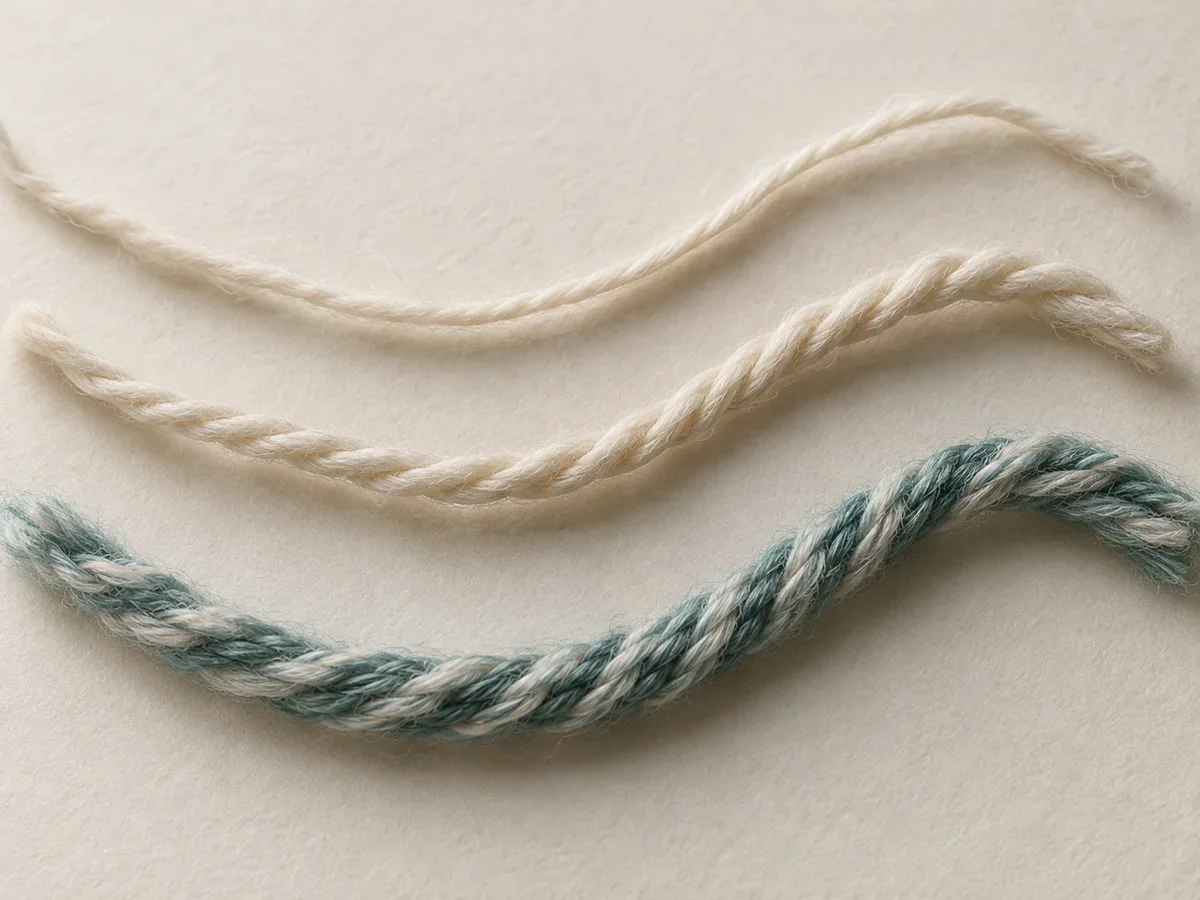
Single, ply and cabled describe yarn construction: one yarn strand, single yarns twisted together, or a further assembly using plied yarns. This page uses the construction-stage distinction taught in Woolwise and illustrated by Cotton Incorporated.12
The construction distinction
| Construction | What is assembled? | Simple example |
|---|---|---|
| Single yarn, also called a singles yarn | One yarn strand, which can be staple-spun, monofilament or multifilament | A single yarn labeled A |
| Ply or plied yarn | Two or more single yarns twisted together | A and B twisted together form a two-ply yarn |
| Cabled yarn | Plied yarns twisted together at a further assembly stage; constructions can also combine plied and single yarns | Two two-ply yarns twisted together form a cable |
These descriptions follow the teaching hierarchy above. The component yarns and the stage at which they are joined establish the distinction.12
Where “folded yarn” fits
Folded yarn is used alongside plied yarn, but reference terminology can overlap more broadly. The 2017 edition of BISFA’s Terminology of Man-Made Fibres gives cabled, folded and plied yarns the same broad definition: two or more single yarns combined through at least one twisting or plying operation.3
The separate stages in the table therefore describe an explanatory convention, rather than a distinction enforced by every reference. When a description is ambiguous, identify the components and their assembly stages.
Following the components
Letters here label example yarns; they are not formal specification notation.
- Two-ply: twist single yarn A together with single yarn B.
- Four-ply: twist four single yarns A, B, C and D together in one plying stage.
- Cable made from two two-ply yarns: first ply A with B and C with D; then twist those two plied yarns together at a further stage.12
The last two examples contain four single-yarn components, arranged through different assembly stages. Counting the original singles alone loses that structural distinction.
Ply count and filament count
A single yarn can contain many fibers or filaments. A multifilament single yarn remains a single yarn at the assembly level. Plying two such yarns produces a two-ply construction, with multiple filaments still present inside each component. Ply count and filament count describe different levels of the structure.12
Assembling yarns without plying
Holding or feeding two yarns alongside one another does not itself twist them into a plied yarn. Cotton Incorporated describes parallel yarns supplied to fabric production as “doubles” and distinguishes them from plied yarns.2 Specify whether the components are merely assembled in parallel or actually twisted together; the word doubling alone can leave the operation unclear.
Twist at each stage
Twist describes the helical arrangement of yarn components. When the yarn is held vertically, an S or Z direction means that the component spirals slope like the middle part of the corresponding capital letter.4
Distinguish twist within a single yarn from twist joining singles into a ply and from twist joining components at a cabling stage. Cotton Incorporated describes singles and ply directions as generally opposite.2 That is a common arrangement, not a universal requirement. State which construction stage a direction describes; a final S or Z label alone does not explain the whole assembly.
For the broader distinction between direction and amount, see Yarn Twist.
What the labels can tell you
The labels describe assembly. Yarn size has a separate mass-per-length or length-per-mass description, while twist influences properties including diameter, handle and strength.5 Consequently, a construction label alone cannot establish thickness, strength or a universal quality ranking. More stages do not, by themselves, demonstrate a better yarn.
For the wider yarn vocabulary, return to Yarn Fundamentals.
Citations
-
- Fundamentals of Yarn Technology — Australian Wool Education Trust / University of New England (Woolwise) · WOOL482/582 Wool Processing, Topic 8 (2012) · 2012. Evidence locator: Section 8.1, printed p. 8-2 (PDF p. 2).
-
- Textile Yarns — Cotton Incorporated / CottonWorks · Textile Yarns, January 2010, 35-page educational booklet · 2010-01. Evidence locator: Section 7.0, p. 24; Figure 26, p. 25.
-
- Terminology of Man-Made Fibres — International Bureau for the Standardization of Man-Made Fibres (BISFA) · 2017 Edition · 2017. Evidence locator: 2017 edition, Chapter 3: Cabled yarn, p. 32; Folded yarn, p. 38; Plied yarn, p. 44.
-
- Terminology of Man-Made Fibres — International Bureau for the Standardization of Man-Made Fibres (BISFA) · 2017 Edition · 2017. Evidence locator: Chapter 3: Twist, p. 49.
-
- Fundamentals of Yarn Technology — Australian Wool Education Trust / University of New England (Woolwise) · WOOL482/582 Wool Processing, Topic 8 (2012) · 2012. Evidence locator: Section 8.2 opening, printed p. 8-3 (PDF p. 3), and Section 8.3 opening, printed p. 8-7 (PDF p. 7).
- Textile Yarns — Cotton Incorporated / CottonWorks · Textile Yarns, January 2010, 35-page educational booklet · 2010-01. Evidence locator: Section 5.0, pp. 21–22.