
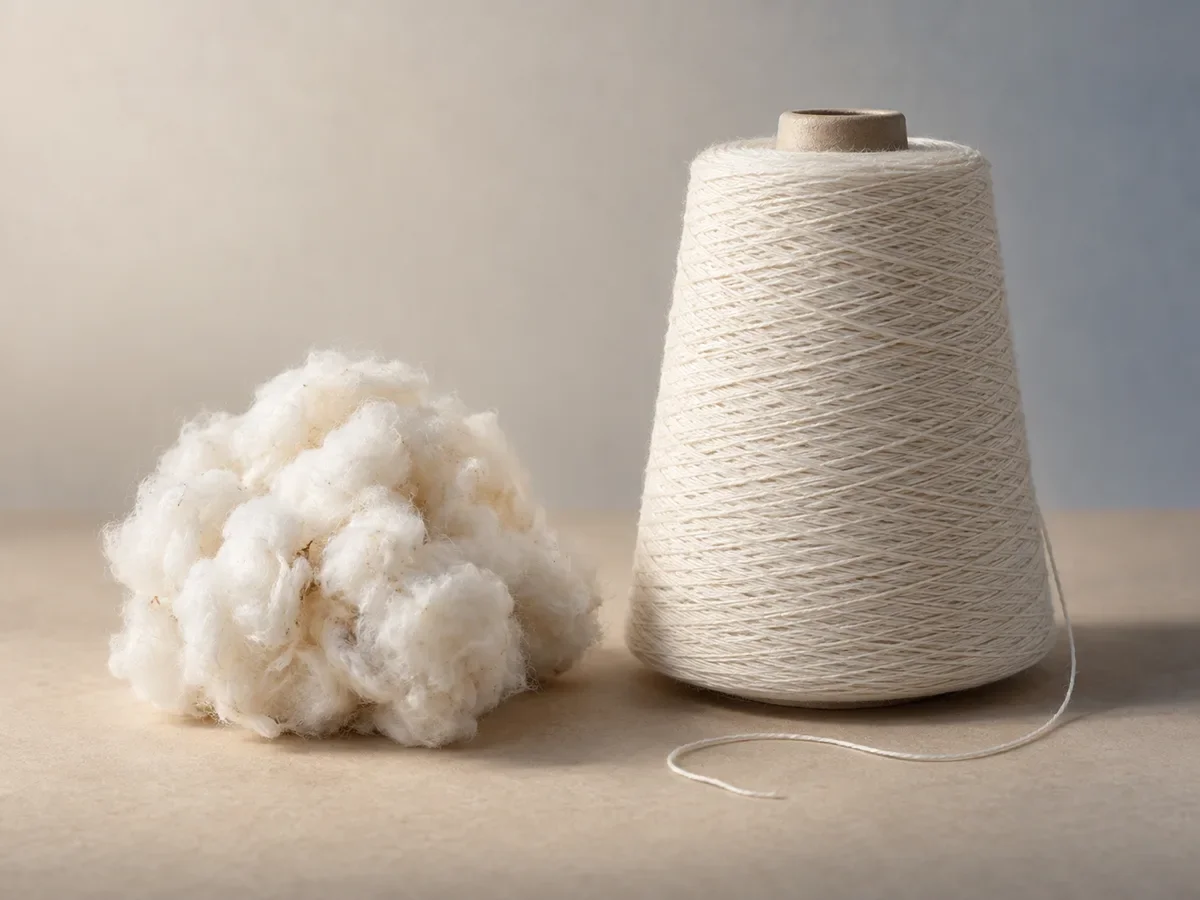
Ring-spun yarn is a yarn made by assembling staple fibers through ring spinning. Staple fibers have finite lengths. Twist holds them together in a continuous strand, with surface fibers following roughly helical paths around the yarn.1
The name describes how the yarn is formed, not its fiber composition. Cotton is one example; ring spinning also processes manufactured fibers and blends, including viscose and polyester blends.2 Read the fiber description alongside the spinning method.
How it is formed
The following sequence uses conventional cotton ring spinning as its example:
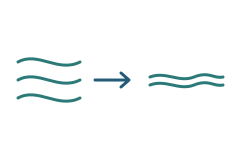
- Feed and draft. A prepared, lightly twisted strand called roving enters the drafting rollers. Drafting draws the strand out, reducing its mass per unit length.3
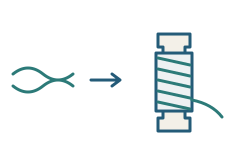
- Insert twist. A rotating spindle carries the bobbin. The traveler works with the ring to insert twist into the emerging strand and enable winding. Friction between traveler and ring contributes to winding tension.4
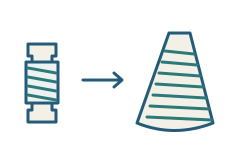
- Wind the yarn. The yarn collects on the bobbin during spinning. A subsequent winding operation transfers it to a larger package suitable for weaving or knitting.5
Winding during yarn formation and the later package-winding operation are separate parts of this cotton route.5 For the broader preparation sequence and intermediate fiber forms, see Spinning Fundamentals.
Reading related descriptions
Carded and combed describe fiber preparation. In cotton processing, carding aligns and cleans the fibers; combing adds removal of short fibers. Either carded or combed material can be prepared as roving for ring spinning. A cotton yarn can therefore be both combed and ring-spun.3
Compact ring spinning adds condensation of the drafted fiber strand before twist insertion. For example, Rieter’s documentation describes the EliTe device as using air to bring the fibers together at this point in short-staple ring spinning.6 This describes the mechanism of a named system; it does not establish a universal performance advantage.
Rotor spinning, also described as open-end spinning in the cited cotton reference, uses a different formation route. It opens a prepared fiber strand into individual fibers and conveys them into a rotating rotor cup, where they join the open end of the forming yarn.7 The distinction here is the formation method, rather than a ranking of quality.
Characteristics, uses, and limits
Twist gives the staple-fiber strand cohesion. Changing twist also changes characteristics such as yarn strength and softness, so the process name alone does not specify those properties.8
Cotton ring-spun yarn is used in woven and knitted textiles.5 These are broad application categories, not a promise of a particular finished-fabric feel. Cotton fiber properties affect the final product, and fabric hand and comfort reflect the combined influence of fiber, yarn, fabric construction, and finishing.9 Accordingly, “ring-spun” alone is insufficient to establish a fabric’s softness or overall quality.
For the distinction between fiber form, yarn construction, twist, and fineness, see Yarn Fundamentals.
Citations
-
- Fundamentals of Yarn Technology — Australian Wool Education Trust / University of New England (Woolwise) · WOOL482/582 Wool Processing, Topic 8 (2012) · 2012. Evidence locator: section 8.1, printed p. 8-2; section 8.3, pp. 8-7 and 8-9, “Self-locking effect”.
- Yarn Spinning — Cotton Incorporated / CottonWorks. Evidence locator: “Ring Spinning,” process paragraph.
-
- Ring Spinning Machine — FAQs (Yarn Manufacture II, Module 3) — Indian Institute of Technology Delhi / NPTEL · Course 116102038, Module 3 FAQs. Evidence locator: “Ring Spinning Machine — FAQs,” Q8–Q9, PDF p. 2, material examples only.
-
- Fiber Preparation for Spinning — Cotton Incorporated / CottonWorks. Evidence locator: “Fiber Carding”; “Drawing,” roller-speed paragraph; “Combing,” first sentence; “Roving,” both paragraphs.
-
- Yarn Spinning — Cotton Incorporated / CottonWorks. Evidence locator: “Ring Spinning,” process paragraph.
- Ring Spinning Machine — FAQs (Yarn Manufacture II, Module 3) — Indian Institute of Technology Delhi / NPTEL · Course 116102038, Module 3 FAQs. Evidence locator: Q18 and Q20, PDF p. 3.
-
- Yarn Spinning — Cotton Incorporated / CottonWorks. Evidence locator: “Ring Spinning,” process and subsequent-winding paragraphs.
-
- EliTe — Compact Spinning System — Rieter / Suessen. Evidence locator: “FOR SHORT-STAPLE RING SPINNING,” first paragraph.
-
- Yarn Spinning — Cotton Incorporated / CottonWorks. Evidence locator: “Rotor Spinning,” final process paragraph.
-
- Fundamentals of Yarn Technology — Australian Wool Education Trust / University of New England (Woolwise) · WOOL482/582 Wool Processing, Topic 8 (2012) · 2012. Evidence locator: section 8.3, opening paragraph, printed p. 8-7.
-
- Fiber Preparation for Spinning — Cotton Incorporated / CottonWorks. Evidence locator: “Considerations for Fiber Selection,” cotton fiber-quality paragraph.
- Kawabata Evaluation System — Wilson College of Textiles, North Carolina State University. Evidence locator: opening three paragraphs before “Compression.”.