
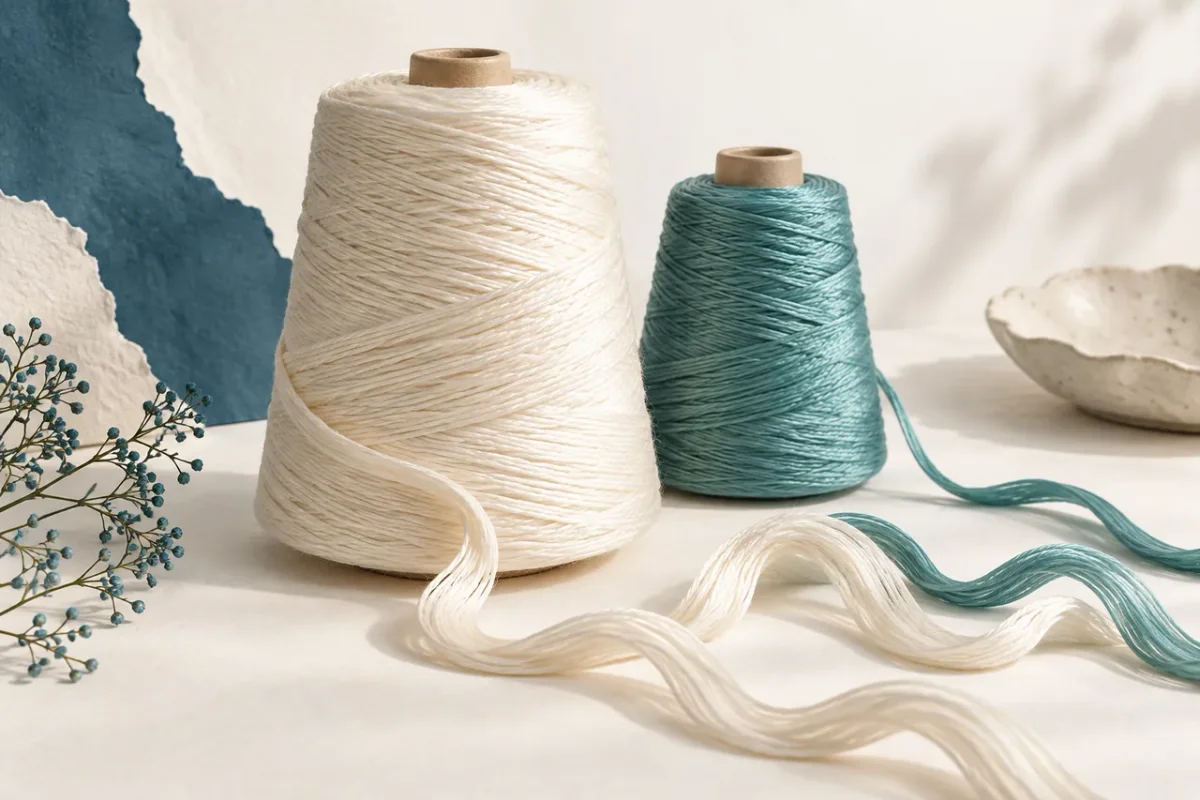

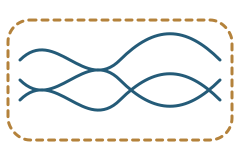



Textured filament yarn is continuous-filament yarn whose filaments have, or can develop, crimp, coils or loops that provide bulk, stretch, or both. The texture may already be present or develop during a later treatment. It describes a yarn structure, rather than one particular fiber material.1
Definition and boundaries
A flat or untextured filament yarn has a comparatively straight filament arrangement. Texturing changes that arrangement while retaining the continuous-filament form. Staple-spun yarn instead assembles fibers of limited length: a textured filament yarn can have a spun-like appearance without becoming staple-spun yarn.12
The category extends beyond polyester. Acar and colleagues studied air texturing of polyester and nylon filament yarns; BB Engineering lists polyester, polypropylene and polyamide among the materials processed by its JeTex air-texturing system. These are examples of material and process combinations, rather than a promise that any material suits every method.3
For the wider context, see Filament Yarn and Yarn Fundamentals.
Two basic texturing mechanisms
False-twist texturing
False-twist texturing applies twist to filament yarn, heat-sets the twisted form, and then untwists it. The resulting yarn can have crimp rather than the original flat arrangement. BISFA distinguishes false-twist stretch yarn from stabilized false-twist yarn with lower crimp extension and contraction; the method’s name alone does not describe one fixed stretch behavior.4
Air-jet texturing
Air-jet texturing feeds excess filament length into a turbulent air stream. This overfeed allows a looped, entangled yarn structure to form. The result can resemble a staple-spun yarn, although its constituent filaments remain continuous. Research by Acar and colleagues emphasizes that forming loops and fixing them into the yarn structure are both necessary parts of the process.2
Air interlacing, also called intermingling, creates distributed interlacing points to give a filament bundle cohesion. It should be distinguished from the overfed, loop-forming air-texturing process.5
Common yarn labels
These abbreviations describe different aspects of yarn production and structure. They are useful together, but should not be read as interchangeable names for textured filament yarn.6
| Label | Meaning and context |
|---|---|
| DTY | Draw-textured yarn. Barmag describes a production route that converts POY supply yarn into DTY. |
| ATY | Air-textured yarn. BB Engineering uses this name for its JeTex output and lists both POY and FDY as feed yarns. |
| BCF | Bulked continuous filament: continuous filament with crimp or bulk. Neumag’s documented application is BCF carpet yarn. |
| POY | Partially oriented yarn, retaining drawability for further orientation. It identifies a feed or production state rather than being another name for textured yarn. |
| FDY | Fully drawn yarn. The name describes drawing state; FDY can be a feed for air texturing, as documented for JeTex. |
Bulk, feel and stretch
Texturing can add bulk and produce a softer feel compared with the flat filament form. These effects should be considered separately from stretch and recovery.7
Crimp can straighten as a yarn extends under tension. Recovery is the tendency to return toward the original form after release. A bulky yarn does not necessarily have high stretch: BB Engineering specifically describes JeTex air-textured yarn as voluminous with low stretch. The stretch and stabilized false-twist categories also show why one stretch description cannot cover every textured yarn.47
Texturing alone does not imply that a yarn contains an elastomeric fiber such as elastane (spandex). BISFA describes elastane-containing yarn constructions separately by their elastic core and covering components. A description of texture should therefore be kept distinct from a description of fiber composition.7
Representative uses
Manufacturer documentation illustrates several uses without establishing universal suitability:8
- Apparel and home textiles: Barmag names these applications for textured yarns made on its DTY machines.
- Apparel, upholstery and curtains: BB Engineering lists these among JeTex air-textured yarn applications, alongside its descriptions of loop-created bulk and a spun-like feel.
- Carpets: Neumag documents BCF carpet-yarn production, illustrating the relevance of bulked continuous filament to this application.
Use the material, texturing route and intended effect together when interpreting these examples. The category name by itself is insufficient to infer a specific stretch or recovery performance.47
Citations
-
- Terminology of Man-Made Fibres — International Bureau for the Standardization of Man-Made Fibres (BISFA) · 2017 Edition · 2017. Evidence locator: Chapter 3, Filament and Filament yarn p. 37, Spun yarn and Staple fibre p. 46, Textured filament yarn p. 48.
- Textile Yarns — Cotton Incorporated / CottonWorks · Textile Yarns, January 2010, 35-page educational booklet · 2010-01. Evidence locator: sections 1.0–2.0, pp. 2–3, Figure 2 p. 4.
-
- Terminology of Man-Made Fibres — International Bureau for the Standardization of Man-Made Fibres (BISFA) · 2017 Edition · 2017. Evidence locator: Chapter 3, Air textured yarn p. 30.
- The mechanism of the air-jet texturing: the role of wetting, spin finish and friction in forming and fixing loops — SAGE / Textile Research Journal; Loughborough University accepted manuscript · Accepted manuscript; journal 76(2), pp. 116-125 · 2006. Evidence locator: accepted manuscript, section 1 p. 1 and section 6 p. 14.
-
- The mechanism of the air-jet texturing: the role of wetting, spin finish and friction in forming and fixing loops — SAGE / Textile Research Journal; Loughborough University accepted manuscript · Accepted manuscript; journal 76(2), pp. 116-125 · 2006. Evidence locator: accepted manuscript, section 3, Supply Yarns p. 4.
- JeTex air-texturizing line — BB Engineering GmbH. Evidence locator: Polymers list.
-
- Terminology of Man-Made Fibres — International Bureau for the Standardization of Man-Made Fibres (BISFA) · 2017 Edition · 2017. Evidence locator: Chapter 3, Crimp p. 34, False twist yarn and False twist stretch yarn p. 36, Stabilised false twist yarn p. 46.
-
- Terminology of Man-Made Fibres — International Bureau for the Standardization of Man-Made Fibres (BISFA) · 2017 Edition · 2017. Evidence locator: Chapter 3, Air textured yarn p. 30 and Interlaced yarn p. 39.
-
- Terminology of Man-Made Fibres — International Bureau for the Standardization of Man-Made Fibres (BISFA) · 2017 Edition · 2017. Evidence locator: Chapter 3, BCF p. 31 and POY p. 44.
- From Melt to Yarn, Fibers and Nonwovens — Barmag. Evidence locator: Solutions & Technologies naming list.
- Solutions for DTY production — Barmag. Evidence locator: opening POY-to-DTY paragraph.
- JeTex air-texturizing line — BB Engineering GmbH. Evidence locator: introduction and Yarn types & denier list.
- Man-made fiber systems — BB Engineering GmbH. Evidence locator: FAQ, specific filament types, FDY entry.
- BCF carpet yarn solutions with BCF S8 and BCF S+ — Barmag / Neumag. Evidence locator: page heading.
-
- Textile Yarns — Cotton Incorporated / CottonWorks · Textile Yarns, January 2010, 35-page educational booklet · 2010-01. Evidence locator: section 2.0 p. 3.
- Terminology of Man-Made Fibres — International Bureau for the Standardization of Man-Made Fibres (BISFA) · 2017 Edition · 2017. Evidence locator: Chapter 3, Crimp elongation p. 34, Elasticity and Extension p. 36, Stabilised false twist yarn p. 46, Chapter 2, elastane-containing yarn constructions p. 29.
- Man-made fiber systems — BB Engineering GmbH. Evidence locator: FAQ, How does air-texturizing work with JeTex?.
-
- Solutions for DTY production — Barmag. Evidence locator: opening application sentence.
- JeTex air-texturizing line — BB Engineering GmbH. Evidence locator: Applications and Effects that affect.
- Man-made fiber systems — BB Engineering GmbH. Evidence locator: FAQ, What are applications of JeTex air-texturizing?.
- BCF carpet yarn solutions with BCF S8 and BCF S+ — Barmag / Neumag. Evidence locator: heading and opening paragraph.