
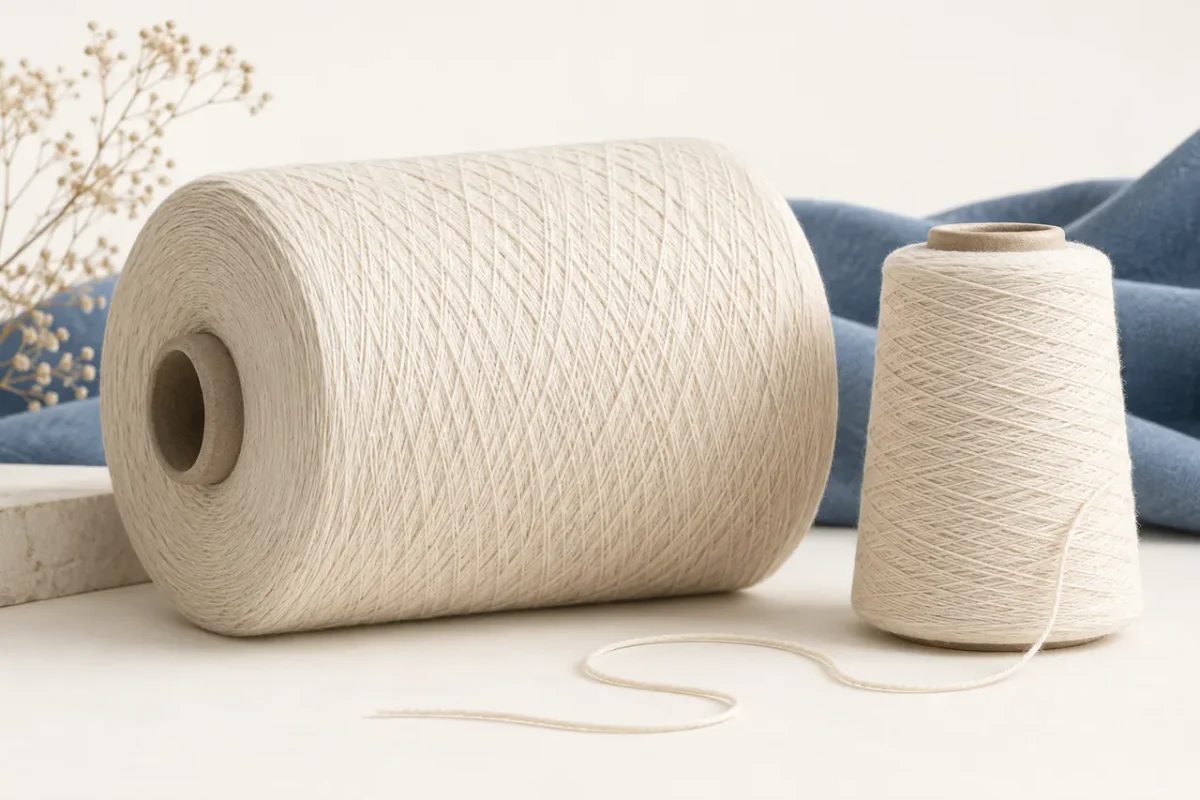

Rotor-spun yarn is a staple-fiber yarn made by separating a prepared fiber strand and reassembling the fibers at an open yarn end inside a rotating rotor. The yarn is withdrawn continuously.1 Staple fibers have finite lengths, unlike the essentially continuous filaments in filament yarn.2
Rotor, open-end and OE
CottonWorks uses open-end yarn, abbreviated OE, for rotor-spun yarn.3 Technically, open-end describes a broader formation principle: individual fibers are collected and joined to a rotating yarn end. Rotor spinning is one implementation; open-end friction spinning is another. The terms therefore need context. This page uses open-end specifically for rotor yarn.4
How the yarn is formed
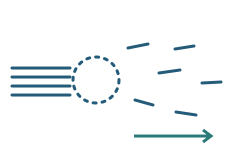
The basic sequence starts with sliver, a prepared strand of fibers:
- An opening roller separates fibers from the sliver.
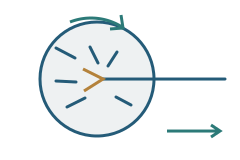
- Suction carries the loose fibers into the rotating rotor cup.
- The fibers join the open yarn end, and rotation inserts twist as the yarn forms.
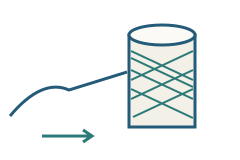
- The yarn is continuously withdrawn and wound into a package.15
Rotor spinning does not need the intermediate roving step used in conventional cotton ring spinning. It also combines yarn formation and package winding on the spinning machine.5
Structure and qualitative characteristics
Rotor yarn has a core of fibers lying largely along its length, with less orderly fibers at the surface. Wrapper fibers encircle the yarn more transversely. This differs from the more regular fiber arrangement described for ring-spun yarn.6
Cotton Incorporated’s introductory comparison describes rotor yarn as more uniform, but generally lower in strength and harsher in hand—its feel—than ring-spun yarn.6 These tendencies are not a universal quality grade. Twist level itself affects yarn strength and softness, so the process name alone is insufficient for a complete comparison.7
Materials, applications and limitations
Cotton is an established rotor-spinning input.1 Manufactured staple fibers and blends also appear in equipment applications: Rieter’s R 37 documentation lists natural and manufactured fiber inputs and gives polyester and polyester-cotton examples. These are examples for that equipment, rather than approval of every fiber blend for every rotor machine.8
Cotton Incorporated lists denim, socks and underwear among open-end yarn applications.9 Treat these as examples, not a recommendation for every fabric in those categories.
Rotor spinning has a narrower yarn-count range than ring spinning, particularly toward finer yarns.10 A fixed count limit or strength difference would need more specific evidence; neither is prescribed here.
For the broader context, read Yarn Fundamentals and Spinning Fundamentals.
Citations
-
- Yarn Spinning — Cotton Incorporated / CottonWorks. Evidence locator: Rotor Spinning, final process paragraph.
-
- Fundamentals of Yarn Technology — Australian Wool Education Trust / University of New England (Woolwise) · WOOL482/582 Wool Processing, Topic 8 (2012) · 2012. Evidence locator: Section 8.1, printed p. 8-2 (PDF p. 2).
-
- Textile Yarns — Cotton Incorporated / CottonWorks · Textile Yarns, January 2010, 35-page educational booklet · 2010-01. Evidence locator: Section 3.2, printed p. 15; Figure 23, p. 20.
-
- The Rieter Manual of Spinning, Volume 6 — Alternative Spinning Systems — Rieter Machine Works Ltd. · 2016; ISBN 978-3-9523173-6-5 · 2016. Evidence locator: Sections 2.1.1, p. 15, and 2.1.4.1, p. 17.
-
- Yarn Spinning — Cotton Incorporated / CottonWorks. Evidence locator: Rotor Spinning, first paragraph, final two sentences; Ring Spinning, process paragraph.
-
- Textile Yarns — Cotton Incorporated / CottonWorks · Textile Yarns, January 2010, 35-page educational booklet · 2010-01. Evidence locator: Section 3.1, p. 13; Section 3.2, pp. 15–16, structure and hand paragraphs, Figure 18.
-
- Fundamentals of Yarn Technology — Australian Wool Education Trust / University of New England (Woolwise) · WOOL482/582 Wool Processing, Topic 8 (2012) · 2012. Evidence locator: Section 8.3, opening paragraph, printed p. 8-7 (PDF p. 7).
-
- Semi-Automated Rotor Spinning Machine R 37 — Rieter. Evidence locator: Technical specification, Technological data, Material row; What customers say, Nishat Mills; Success stories, polyester entry.
-
- Textile Yarns — Cotton Incorporated / CottonWorks · Textile Yarns, January 2010, 35-page educational booklet · 2010-01. Evidence locator: Section 4.2, printed p. 20, application paragraph.
-
- Yarn Spinning — Cotton Incorporated / CottonWorks. Evidence locator: Rotor Spinning, paragraph beginning “Yarn count range”.