
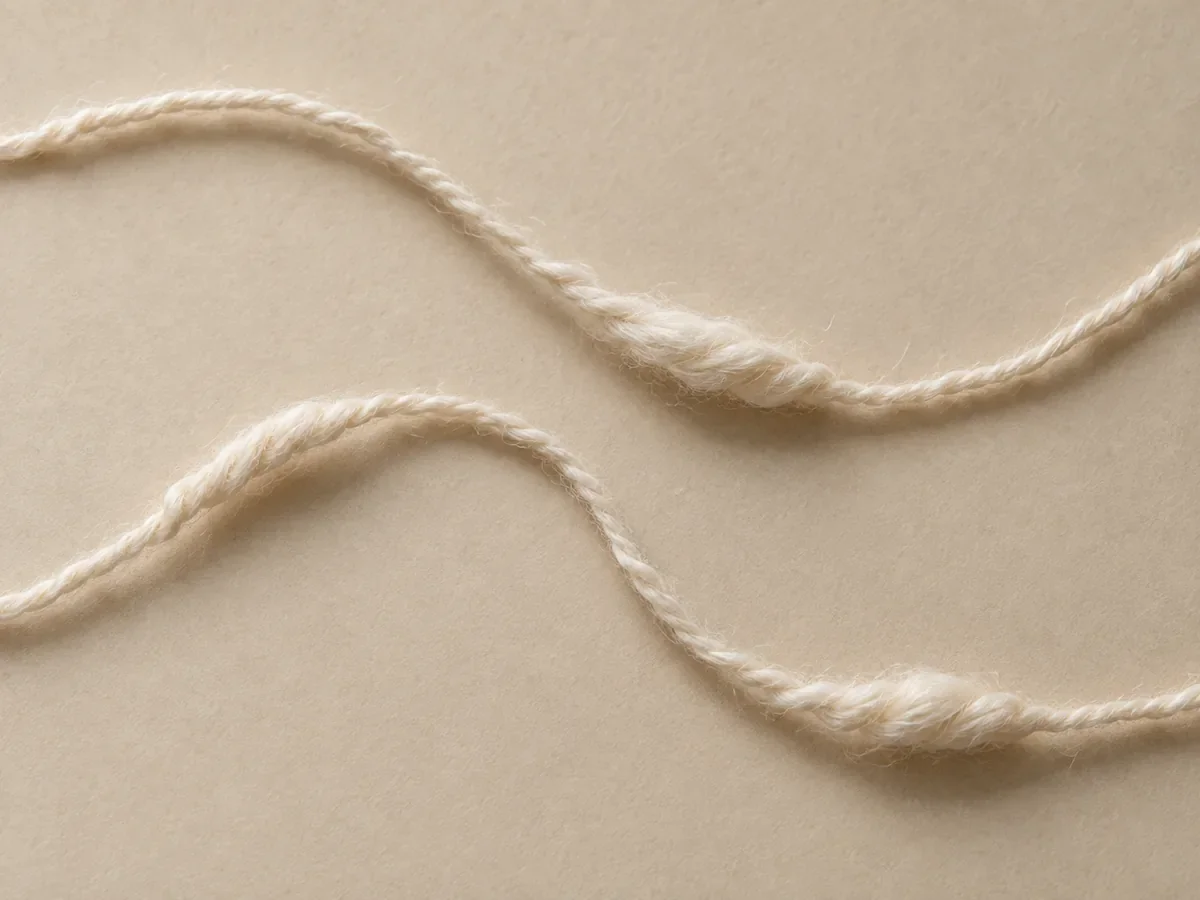
A slub yarn has deliberately varied thickness along its length. Its locally thicker sections create a visible effect when the yarn becomes fabric. It is one kind of specialty or special-effect yarn: a broader group designed for a particular appearance. Textile references also use fancy and novelty yarn for effect yarns. Those labels cover more than slub alone.1 See Yarn Fundamentals for the wider yarn vocabulary.
What makes a slub effect?
Think of a base yarn interrupted by thicker sections, or slubs. Their length, degree of thickening, and distance from one another influence how the effect appears. Some yarns show distinct thick sections; in others, smaller effects make the yarn look more continuously uneven. There is no single spacing or size that describes every slub yarn.2
A thick place is not automatically an intended slub. It may be an unwanted irregularity. The useful distinction is whether it belongs to the yarn’s planned effect. In production, a slub outside the intended dimensions or a stretch missing intended slubs can be treated as a fault. Appearance alone cannot always establish the maker’s intention; a reference sample or the intended pattern provides context.3
How is the effect made?
The effect can be introduced by controlling variation while the yarn is spun. A spinner may set a pattern of thicker sections, but the resulting yarn also depends on the spinning system and the material being processed. Ring and open-end spinning are both documented routes for slub effects. This is a description of the principle, not a machine-setting recipe.4 For the broader process, see Spinning Fundamentals.
Terms that sound similar
Slub names the local thick effect. Fancy, novelty, and special-effect describe a wider range of yarn effects; for example, bouclé has a looping effect rather than the same thick-section pattern. Uster also distinguishes slub yarn from multicount yarn, where the yarn count changes over longer sections, and multitwist yarn, where twist changes. These are useful conceptual distinctions, although naming may vary between suppliers.5
Where it appears and what to check
Slub effects are used to give fabrics visible texture or variation. Engineered denim is one documented example; slub yarns also appear in home textiles, shirting, and knitted goods. The chosen effect influences the finished appearance.6
When evaluating a yarn for an intended look, compare a sample with the desired fabric effect and describe the thick sections, their spacing, and how much variation is acceptable. An intentional effect still needs control: missing effects, unexpected thick places, or an unwanted repeat can change the fabric’s appearance. The word slub by itself does not specify strength, abrasion behavior, or another performance result.7
Citations
-
- Textile Yarns — Cotton Incorporated / CottonWorks · Textile Yarns, January 2010, 35-page educational booklet · 2010-01. Evidence locator: §8.0–8.3, printed pp. 25–27.
-
- Measurement and Clearing of Slub Yarns — Uster Technologies AG · Uster News Bulletin No. 46, October 2008 · 2008-10. Evidence locator: §§4.2 and 5, printed pp. 9–14.
- Textile Yarns — Cotton Incorporated / CottonWorks · Textile Yarns, January 2010, 35-page educational booklet · 2010-01. Evidence locator: §8.1 and Fig. 27, printed pp. 25–26.
-
- Measurement and Clearing of Slub Yarns — Uster Technologies AG · Uster News Bulletin No. 46, October 2008 · 2008-10. Evidence locator: §5 “Slub Yarn Configuration,” printed p. 12; §§8–9.2, printed pp. 28–30.
-
- Textile Yarns — Cotton Incorporated / CottonWorks · Textile Yarns, January 2010, 35-page educational booklet · 2010-01. Evidence locator: §8.1, printed p. 26.
- Measurement and Clearing of Slub Yarns — Uster Technologies AG · Uster News Bulletin No. 46, October 2008 · 2008-10. Evidence locator: §2, printed pp. 6–7.
-
- Textile Yarns — Cotton Incorporated / CottonWorks · Textile Yarns, January 2010, 35-page educational booklet · 2010-01. Evidence locator: §§8.1 and 8.3, printed pp. 25–27.
- Measurement and Clearing of Slub Yarns — Uster Technologies AG · Uster News Bulletin No. 46, October 2008 · 2008-10. Evidence locator: §4.1, Table 1, printed p. 8.
-
- Textile Yarns — Cotton Incorporated / CottonWorks · Textile Yarns, January 2010, 35-page educational booklet · 2010-01. Evidence locator: §8.1, printed p. 25.
- Measurement and Clearing of Slub Yarns — Uster Technologies AG · Uster News Bulletin No. 46, October 2008 · 2008-10. Evidence locator: editorial, printed p. 2.
-
- Measurement and Clearing of Slub Yarns — Uster Technologies AG · Uster News Bulletin No. 46, October 2008 · 2008-10. Evidence locator: §§8–9.2, printed pp. 28–30.