
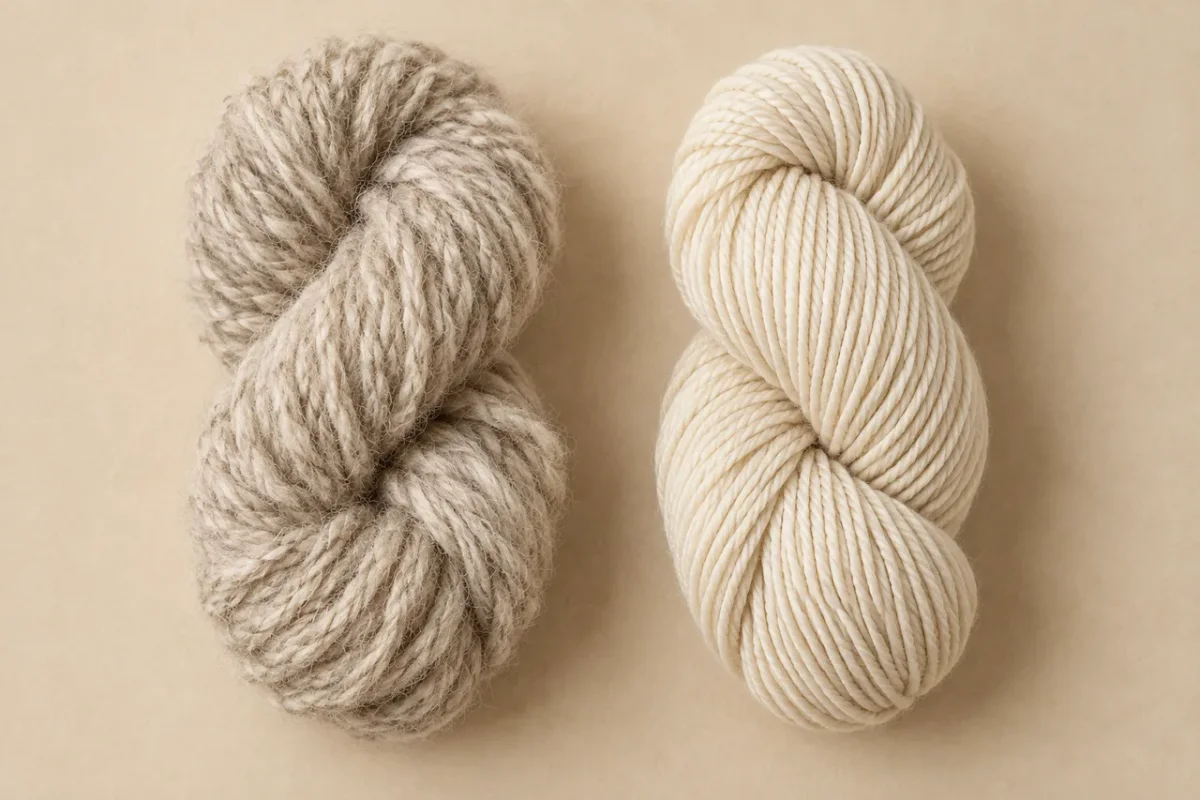
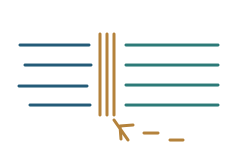
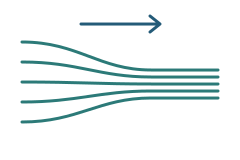
Woolen and worsted describe two routes for turning wool into yarn. Their central difference is fiber preparation: the woolen route uses carded fibers without combing, while the worsted route adds alignment and combing before spinning.1
What the names mean
Here, woolen and worsted identify processing systems, rather than different kinds of raw wool. Woollen is the spelling used in the cited technical sources for the woolen system. Read the fiber composition separately from the system name.2
The terms can also describe textiles made from these yarns. A woolen or worsted fabric description should therefore be read in its yarn-production context; it does not name a weaving or knitting method.3
Worsted weight has a separate meaning in craft yarn labeling. The Craft Yarn Council places “Worsted” in its Medium yarn-weight category. That category describes yarn size, rather than establishing that the yarn followed the worsted processing route.4
How preparation differs
The usual fiber-length profile differs too: Woolmark’s comparison describes shorter fibers for woolen yarn and longer fibers for worsted yarn. These are typical profiles, not fixed length thresholds.5
Both routes use carding: separating and disentangling fibers. “Carded versus combed” is useful shorthand only if it does not suggest that worsted yarn skips carding.1
- Woolen: the carded fiber web is divided into narrow strands called slubbings. These go to spinning without a combing stage, retaining a less orderly fiber arrangement.15
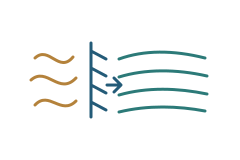
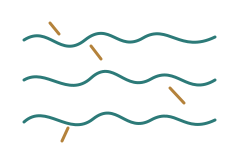
- Worsted: carding produces a sliver, an untwisted strand of fibers. Gilling improves alignment; combing removes shorter fibers and remaining impurities. The prepared fibers are then drawn into a finer feed before spinning.15
Spinning draws out the feed and inserts twist to bind the fibers into yarn in both routes. Woolen spinning uses less drawing than the conventional worsted route described here.1
Typical yarn structure
| Aspect | Woolen | Worsted |
|---|---|---|
| Fiber arrangement | Less orderly, with fibers changing direction | More parallel along the yarn |
| Surface | Typically hairier, with protruding fibers | Typically smoother |
| Overall character | Relatively bulky | Relatively lean |
These are characteristic tendencies, not guarantees for every yarn. Woolen fiber paths create spaces within the yarn, but its bulky character also depends on twist. The comparison does not establish a universal fiber-length cutoff or measured density difference.5
Common uses and limits
Heavier jackets and sweaters illustrate woolen applications; traditional tailoring illustrates a worsted application. Both systems can supply yarn for woven and knitted products. These examples are not exclusive uses.3
A system label is not a complete quality or performance specification. Fiber dimensions, yarn fineness, twist, fabric structure, and finishing also matter. The Woolmark knitwear guide, for example, discusses finishing changes to fabric bulk and softness alongside yarn-selection factors.6
Use the comparison to understand preparation and typical appearance. It does not determine which finished product is warmer, stronger, softer, more durable, or better for a particular purchase.
For the broader terminology, see Yarn Fundamentals and Spinning Fundamentals.
Citations
-
- Wool Processing — The Woolmark Company. Evidence locator: Woollen carding; Woollen spinning; Carbonising, paragraph on absence of combing; Worsted carding; Gilling; Combing; Roving; Worsted spinning.
-
- Wool Processing — Australian Wool Education Trust / Woolwise · WOOL 382-482; revised 2012 · 2012. Evidence locator: Topic 1 — Overview of Early Stage Processing, introduction and learning objectives.
- Wool Processing — The Woolmark Company. Evidence locator: opening paragraph.
-
- Wool Processing — The Woolmark Company. Evidence locator: opening paragraph; What is woollen yarn?; What is worsted yarn?.
-
- Standard Yarn Weight System — Craft Yarn Council. Evidence locator: Standard Yarn Weight System, Type of Yarns in Category row, Medium column.
-
- Value and Use of Wool — Topic 21, WOOL422/522 — Australian Wool Education Trust / Woolwise; University of New England · WOOL422/522 Wool Marketing & Clip Preparation, Topic 21 · 2012. Evidence locator: section 21.16, printed p. 21-16 / PDF p. 16; Characteristics of woollen spun yarn, printed p. 21-29 / PDF p. 29.
- Introduction to Knitwear — Training Manual — The Woolmark Company. Evidence locator: printed p. 6 / PDF p. 6, Yarn Qualities comparison.
-
- Introduction to Knitwear — Training Manual — The Woolmark Company. Evidence locator: printed pp. 7–9 / PDF pp. 7–9, Yarn Selection; Worsted or Woollen; selection-attribute bullets; Fibre Diameter.